
How Are Cricket Bats Made in Meerut?Ten stages from cleft to finished bat — written from inside a working workshop
Almost nobody who owns a cricket bat has seen one being made. That is a shame, because the process explains every difference between a good bat and a poor one — and most of those differences are invisible by the time it reaches a shop.
Why Meerut
Meerut has made sports goods for over a century. Cricket bat manufacturing concentrated here through a combination of established trade skills, supply chain access, and generations of craftsmen passing the work down — the same way any specialist industry clusters in one place.
Today the city produces a large share of the world's cricket bats. The willow is imported; the skill is local.
That is worth stating plainly because “made in Meerut” is sometimes treated as a qualifier. It is not. English willow is Salix alba caerulea, grown almost entirely in England, and it is imported from specialist willow merchants by bat makers in Meerut, in England and in Australia alike. The timber is the same. What differs is what happens to it next.
Ten stages, cleft to finished bat
Clefts arrive
English willow clefts come from specialist willow merchants in England; Kashmir willow comes from the northern regions the name suggests. They arrive as wedges — split, not sawn, so the split followed the grain — already seasoned to bring moisture content into the correct band.
Why it matters: A cleft too wet will not press properly. Too dry and it becomes brittle. Everything downstream depends on getting this right before we see it.
Grading
Every cleft is inspected individually. Fibre straightness through the blade, evenness of density from toe to shoulder, absence of soft patches or internal cracking, moisture content within a narrow band.
Why it matters: This is where a bat's grade is decided — before a single cut is made. Cosmetic appearance correlates with quality but is not what we grade on. A cleft can look perfect and be rejected for something invisible from outside.
Pressing — eight stages
The cleft goes under hydraulic pressure, and the pressure is raised progressively across the face, the edges and the toe. Eight separate stages, not one.
Why it matters: This is the step most often shortened. Two to four stages is common across the industry, because pressing takes time and time costs money. Under-pressed willow marks on the first delivery and the ball dies on contact. No amount of knocking in rescues it.
Shaping the blade
Now the bat becomes a bat. A craftsman cuts the profile — where mass sits along the blade — then the edges, the spine, the concaving and the toe. On our tennis bats, the scoops and spines are cut at this stage.
Why it matters: This is the part that cannot be automated meaningfully. Every cleft is slightly different, and the person shaping it is reading the timber as they go.
The handle
Multi-piece cane with rubber inserts between the layers, cut to length and shaped — round, oval or semi-oval, whichever was ordered.
Why it matters: Cane rather than willow because the jobs differ. The blade returns energy; the handle absorbs the jarring a hard ball sends back up the bat.
The splice
A V-shaped socket is cut into the top of the blade and the handle is glued into it. The joint has to be exact — a splice that is slightly off will fail under load, often months later.
Why it matters: This is the single most skill-dependent join on a cricket bat, and splice separation is one of the harder repairs. It is also why you should never oil the splice: oil weakens the glue.
Binding
Twine is wound tightly around the handle, holding the cane layers together under load.
Why it matters: Invisible once the grip goes on, and structural. If the binding frays the handle loses support and failure follows. Check it whenever you change a grip.
Toe guard and finishing
A reinforced toe guard is fitted, the blade is sanded and finished, stickers applied.
Why it matters: The toe is end grain — the fibres are cut open there, so it absorbs moisture faster than anywhere else on the bat. A toe guard should not be an optional extra.
Engraving
If a name was ordered, it is laser engraved into the willow — cut in, not printed on, so it does not wear off.
Why it matters: Free on every bat we make, up to eighteen characters.
Weighing and final check
Every bat is weighed against the specification it was built to, and inspected before packing. If it misses, it does not go out.
Why it matters: This is where a built-to-order workshop differs from a production line. We are checking against your specification, not a batch tolerance.
The stage that is most often shortened
If you take one thing from this article, take this.
Pressing is where corners get cut, and it is invisible to the buyer. Raw willow is fibrous and relatively soft. A hard ball striking it would dent the surface and lift the fibres. Pressing compacts the timber under hydraulic pressure so it absorbs and returns impact instead.
The reason it is done in stages is that willow has to be compacted progressively. Pressure raised gradually across the face, the edges and the toe hardens the surface without making the blade brittle. Rush it and you get a bat that is hard and dead rather than hard and lively.
Ours is eight stages. Two to four is common. Not because other makers are careless, but because pressing takes time, time costs money, and a bat that has been pressed four times looks identical to one pressed eight times right up until someone hits a ball with it.
The tell, if you ever want to check one: under-pressed willow marks on the first delivery, the ball dies on contact rather than springing off, and the face shows deep seam impressions after a single session. No amount of knocking in rescues a bat that was not pressed properly. It is the one defect that cannot be fixed later.
What machines cannot do
Two stages resist automation, and they are the two that decide how a bat plays.
Grading
Every cleft is different. Fibre straightness, density evenness, soft patches, moisture — a machine can measure some of that, but the judgement of whether this cleft will press well and hold a profile is made by someone who has handled tens of thousands of them.
Shaping
A machine can cut to a template. It cannot read the timber as it goes — decide that this cleft needs a fraction less taken from the edges, or that the spine should stay slightly higher here because of how the density runs.
That is why a bat shaped by hand can be built to an individual specification and a bat cut to a template cannot. Both are legitimate products; they are not the same product.
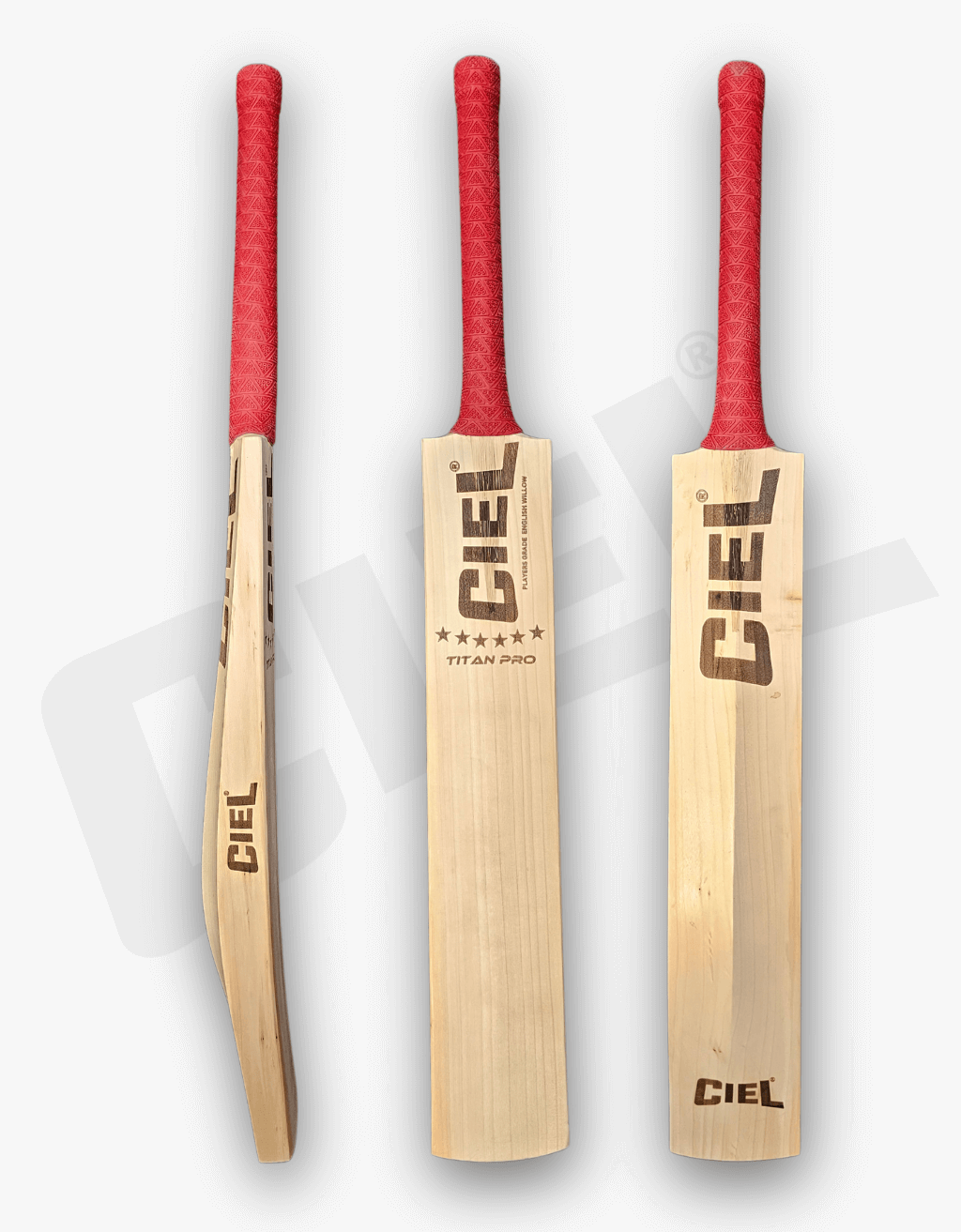
Forty a day, not three thousand
Large factories in Meerut produce three thousand bats a day or more. We make a maximum of forty.
That is not a boast about being artisanal. It is an explanation of what we can and cannot offer.
At forty a day, every bat can be built to an individual specification — profile, handle shape, toe shape, size, exact weight, engraving. Someone can look at a cleft, read the order, and shape that particular piece of willow to that particular request.
At three thousand a day, that is arithmetically impossible. A high-volume factory picks a handful of bats to lavish attention on — the ones going to sponsored players and shop windows — and the rest go out as they came off the line. That is not a criticism; it is how volume manufacturing works in any industry.
It does mean the two businesses are selling different things at similar prices, which is worth knowing before you buy either.
The thing the trade rarely says out loud
A great many bats sold under international brand names are made in Meerut. This is not a secret within the trade, though it is rarely advertised on the sticker.
We are not saying that to disparage anyone. We are saying it because it reframes the question people usually ask.
“Where was it made?” is rarely the useful question. These are:
- “How many pressing stages?” A maker answers with a number.
- “What are your grading criteria?” A maker describes the cleft — fibre, density, moisture. A reseller gives you a brand name.
- “How many bats a day do you make?” The answer tells you whether individual attention is possible.
- “Can I choose the profile and the weight?” If not, they are not shaping the bat.
- “Will you send photographs of my actual bat before it ships?” Only possible if they have it in their hands.
Why any of this matters to you
Three practical consequences.
The price you pay is mostly supply chain above a point. A bat that passes through a distributor, a wholesaler and a retailer carries three margins on top of the cleft. Buying direct removes all three — which is why our English willow starts at ₹7,999 rather than considerably more, and our Kashmir willow at ₹4,499.
Customisation is a manufacturing question, not a pricing one. Profile, handle shape, toe shape, size, weight and engraving are free on every bat we make — not as a promotion, but because the bat is being shaped after you order it anyway. A reseller cannot offer that at any price, because the shaping decisions were made months earlier in a factory they do not control.
When something goes wrong, there is nobody in between. A warranty claim with a manufacturer is a conversation. With a reseller it is an argument between you, them, and a factory you cannot contact.
Build one yourself
Our bat builder takes you through the nine specifications we build to and sends the finished spec straight to Akshat and Utkarsh on WhatsApp. They will tell you honestly whether your weight is achievable in that grade and profile before anything is made — which is the part of this process that matters most to you and costs us the least to get right.
Questions people ask
Why are so many cricket bats made in Meerut? +
Meerut has been a centre of sports goods manufacturing for over a century, and cricket bat making concentrated there because of a combination of established trade skills, supply chain access and generations of craftsmen passing the work down. Today it produces a large share of the world's cricket bats, including a substantial number sold under brand names recognised internationally.
Are Meerut-made cricket bats good quality? +
The question is not where a bat was made but who made it and how. English willow is imported from England by makers in Meerut, in England and in Australia alike - the timber is the same. What differs is cleft selection, pressing and shaping. There are excellent bats and poor bats made in Meerut, as there are anywhere.
How many stages of pressing does a cricket bat need? +
More than most bats get. Ours go through eight hydraulic press stages with pressure raised progressively across the face, edges and toe. Two to four stages is common across the industry because pressing takes time and time costs money. Under-pressed willow feels dead, marks on the first delivery and cannot be rescued by knocking in.
How many bats does a Meerut factory make in a day? +
It varies enormously. Large factories produce three thousand a day or more. We make a maximum of forty, which is what allows every bat to be built to an individual specification - profile, handle shape, toe shape, size, exact weight and engraving. A factory producing three thousand cannot give each bat that attention.
Where does English willow come from? +
England, almost entirely. Salix alba caerulea, the cricket bat willow, is grown there for this purpose and is not cultivated at scale anywhere else. Bat makers worldwide import clefts from specialist willow merchants, which is why the timber is the same whoever makes the bat.
What part of bat making cannot be automated? +
The shaping. Every cleft is slightly different in density and fibre, and the craftsman shaping it is reading the timber as they go - deciding how much to take from the edges, how high to leave the spine, where the mass should sit. Machines can cut to a template; they cannot respond to the material.
Can I visit a cricket bat factory in Meerut? +
Ours is a working workshop rather than a visitor centre, but we film it and put it on our YouTube channel, and we are happy to answer any question about the process on WhatsApp. If you are in Meerut and genuinely want to see how a bat is made, message us and we will see what we can arrange.
Do big cricket brands make their bats in Meerut? +
Many bats sold under international brand names are made in Meerut. That is not a secret in the trade, though it is rarely advertised. The question worth asking any seller is what their grading criteria are and how many bats a day they produce - those tell you far more than a country of origin does.
How long does it take to make one cricket bat? +
The hands-on work is a matter of hours, but the process spans days because of pressing, gluing and finishing time. We quote five days to build a bat to your specification from the point we confirm it, plus transit. For wholesale quantities we quote ten days.
What is the difference between a handmade and machine-made bat? +
Almost no cricket bat is entirely one or the other. Pressing is always mechanical - it has to be. Shaping is where the difference lies: a bat shaped by hand can be built to an individual specification and responds to the particular cleft, while a bat cut to a template cannot. Both are legitimate; they produce different products.
Does buying direct from a Meerut factory save money? +
Yes, and it is most of the price difference at the upper end. A bat that passes through a distributor, a wholesaler and a retailer carries three margins on top of the cleft. Buying direct removes all three - which is why our English willow starts at ₹7,999 rather than considerably more.
Can I get a bat made to my own specification? +
Yes, and at no extra cost. Five player profiles, three handle shapes, three toe shapes, seven sizes, your exact weight and laser engraving are included in the price of every bat we make. The only paid addition is our preparation service at ₹1,000, which covers oiling, knocking in and fibre tape before dispatch.
More on what happens to the willow: what English willow actually is, how clefts are graded, and how the shaping decides where your sweet spot sits.
Made in Meerut · Forty a day, built to order
Buy from the workshop, not the shop
English willow ₹7,999–₹59,999 · Kashmir willow ₹4,499–₹5,999 · Hard tennis ₹3,499 · 8-stage hydraulic pressing on every bat · Five profiles, three handle shapes, your size and weight, laser engraving — all free · 12-month handle warranty