



Home/English Willow Cricket Bats/Dominator
Grade 1+ English Willow · Our most chosen bat
DominatorGrade 1+ English Willow Cricket Bat — 7–9 Grains
Tighter grain, a cleaner face, and the cleft quality most of our customers settle on. The bat serious club and academy cricketers keep coming back for.
You save ₹13,000 · Free shipping across India · Ships to 50+ countries

Overview
The best English willow cricket bat under ₹40,000
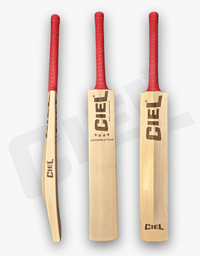
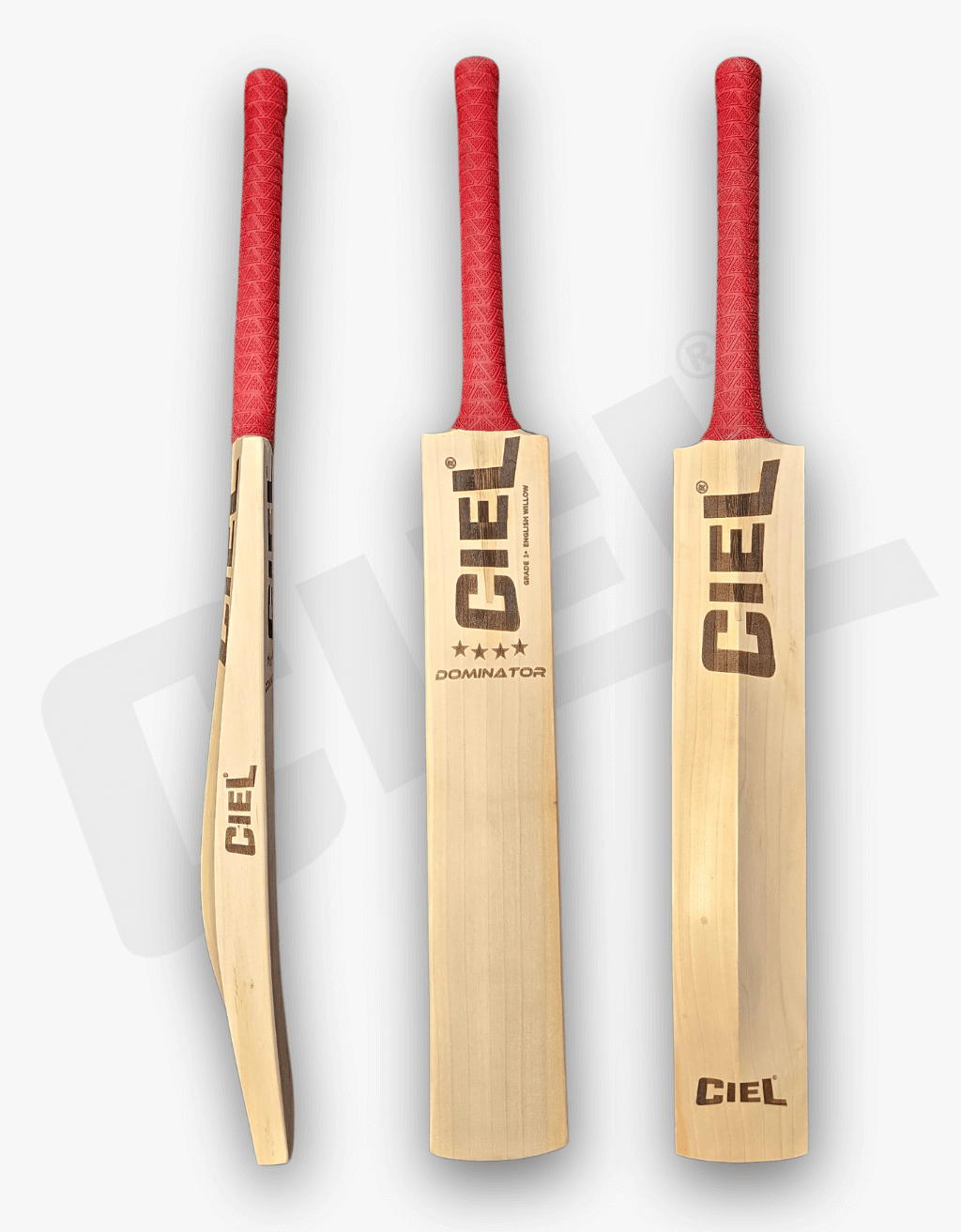
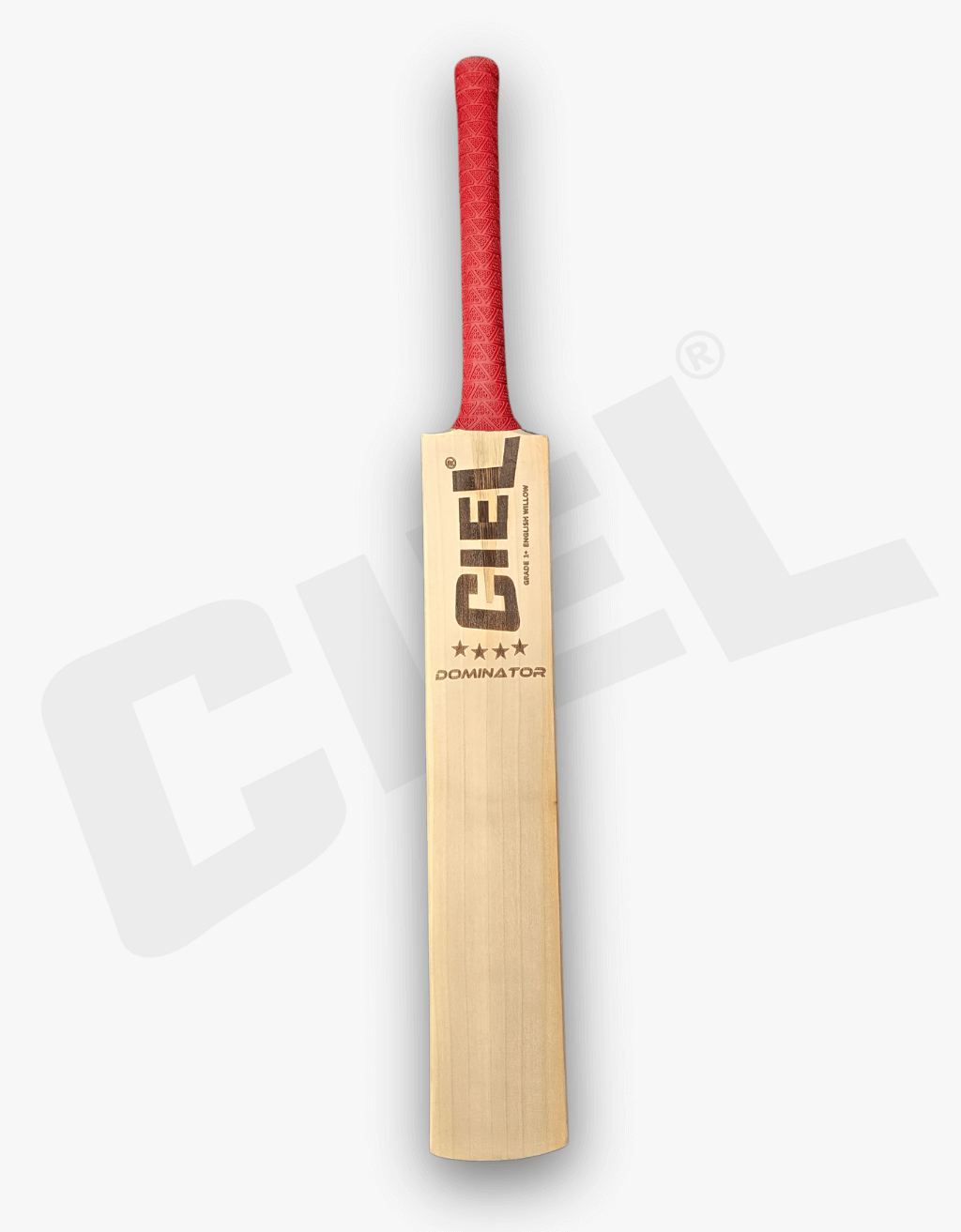
The Dominator is our Grade 1+ English willow cricket bat and the one most of our customers end up choosing. It carries 7–9 straight grains, 40–42mm edges and a 63–66mm spine, with a weight range of 1150–1250g and a Sarawak cane handle. Every Dominator is hydraulically pressed through eight stages and hand-shaped in our own Meerut facility.
Grade 1+ sits one step above Grade 1 and one below Player Grade. In practice that means tighter grain spacing, a cleaner face, and timber that was more mature when it was felled. Any speckling or tonal variation that remains is a characteristic of natural willow rather than a defect — and as our grain guide below explains, a face with no marks at all is often a face that has been treated.
The Dominator shares its edge profile with our Striker, and that is deliberate. The ₹16,000 between them buys cleft quality, not a bigger bat. If your cricket does not demand that step, the Striker will serve you well — we would rather say so here than have you find out later.
The straight answer first
Is the Surge the right English willow bat for you?
We make nine English willow bats and a full Kashmir willow range. The Surge is not the right answer for everyone — and we'd rather tell you here than have you find out four weeks into the season.
Buy the Dominator if
- You play serious club, academy, league or district cricket week in and week out
- You want the cleanest willow available before Player Grade pricing begins
- You've owned Grade 1 before and you know the step up is worth it for your standard of cricket
- You want tighter grain spacing and a face that stays presentable across a full season
- You want the bat shaped to your sweet spot, size and handle rather than pulled off a shelf
Grade 1+ describes the cleft — grain tightness, straightness, face cleanliness. The pressing, the Sarawak cane handle, the 12-month warranty and the customisation are identical to every bat we make, from the ₹7,999 Surge upward.
Buy something else if
- You play club cricket at a steady level. The Striker at ₹20,999 shares the same edge profile and build for ₹16,000 less.
- You're a power hitter chasing maximum mass. The Inferno at ₹23,999 has 42mm+ edges and no concaving.
- You play representative or professional cricket. The Titan Pro at ₹49,999 is Player Grade with 8–12 grains.
- You play mostly tennis ball cricket. English willow is the wrong timber for it — our Kashmir willow range is built for that game and costs far less.
Not sure whether Grade 1+ is the right step? Message Akshat or Utkarsh on WhatsApp — they handle custom orders personally and will tell you honestly.
Written by the manufacturer, not a review site
What ₹36,999 actually buys you
We press, shape and finish every bat in our own Meerut facility. Here's what that changes about the Surge.
Grade 1+ — tighter grain, and what that actually changes
A Grade 1+ cleft has everything Grade 1 requires — straight grains, no run-out at the edges, an even face — plus tighter spacing between the grains. Tighter spacing means the tree laid down its rings more slowly, which generally produces a denser, crisper blade that responds sharply off the middle from earlier in its life. It is a real difference, and it is also a smaller one than the price gap implies. We would rather you knew that before buying than after.
Eight hydraulic press stages — the same process as our premium bats
Every Dominator passes through eight separate hydraulic press stages, pressure raised progressively across face, edges and toe. Most bats at this price see two to four, because pressing takes time and time costs money. The extra stages compress the surface fibres into a harder, more responsive skin — which is why the Dominator arrives closer to ready than most bats at this grade, and why the ping holds through a full season. This is the one thing we won't cut, at any price point.
Every cleft inspected by hand before it becomes a bat
Clefts arrive pre-graded, but grading happens in bulk and it misses things. Before a cleft is pressed, one of our bat makers checks it individually for grain run-out, internal cracks, soft patches and toe integrity. Clefts that fail are rejected outright rather than quietly moved down a grade. A Dominator is a sound, tight-grained cleft — the grade describes how clean it looks, never how well it was made.
Factory direct — you pay for willow and labour, nothing else
A bat leaving a Meerut factory normally passes through a distributor, a wholesaler and a retailer before it reaches a player, each adding margin. We removed all three. That is the entire reason a hand-made Grade 1+ English willow bat sits at ₹36,999 here rather than at the multiple of that figure Grade 1+ willow normally reaches once it has passed through a retail chain. Meerut makes the large majority of the world's cricket bats — the Surge is simply one bought at the source rather than at the end of the chain.
Built to your specification, not to a warehouse average
Customisation is normally reserved for the top of a range. On the Dominator you still choose your sweet spot from five player profiles, your size from seven, your handle shape from three, and you can request a weight preference so we hand-pick a matching cleft. Nothing is pre-made and warehoused. Your bat is shaped after you order it — which is why the pickup feels like yours rather than an average.
Full specification
Dominator English willow bat — full specification
| Specification | Dominator |
|---|---|
| Ball type | Leather ball cricket only |
| Sizes available | SH · LB · LH · LBLH · Harrow · Size 6 · Size 5 |
| Handle shapes | Round · Oval · Semi-oval |
| Sweet spot positions | Five player profiles — you choose |
| Toe guard | Reinforced rubber |
| Face protection | Anti-scuff sheet fitted |
| Knocking in required | 6–8 hours |
| Weight variation | ±20g — natural to genuine willow |
| Shipping | Free across India · 50+ countries worldwide |
| Made in | Meerut, Uttar Pradesh, India |
Where the Surge sits
All 9 Ciel Sports English willow cricket bats compared
Every bat below is the same willow species, through the same eight press stages, with the same 12-month handle warranty. What changes as you move up is the cleft — grain count, straightness, and how clean the face is.
Choose your sweet spot
Cricket bat sweet spot positions — five player profiles
Sweet spot position changes where the mass sits in the blade — which changes how the bat picks up and which shots come naturally. Choose at checkout, or ask us if you're unsure.
Mass through the middle of the blade. Suits front-foot drivers and technically orthodox players.
The most versatile position. Suits openers and top-order players who cut, pull and drive equally.
Mass low toward the toe. Suits finishers, yorker-hitters and lower-order power hitting.
Mass spread across the blade with no weak zone. Suits T20 hitters clearing the rope from anywhere.
The classic all-round profile. Suits players across all formats and all conditions.
Read the bat before you buy it
How to read the grain on an English willow bat
Grain count is the number every bat is sold on and the one buyers understand least. Here is what the face is actually telling you.
What a grain is
Each vertical line on the face of an English willow bat is one growing season in the life of the tree. A seven-grain cleft came from timber that laid down seven visible rings across the width of that blade. Because willow grows quickly when young and more slowly as it matures, a high grain count generally indicates older, denser timber — and tighter spacing between grains indicates slower growth.
Why more grains is not automatically better
Denser timber gives a crisper initial response, which is why high-grain bats feel immediately lively. But density cuts both ways: a very tight-grained blade can be more brittle in its early life and less forgiving if it is not knocked in properly. Fewer, wider grains mean younger, softer timber that absorbs impact rather than resisting it, which is often more durable in the first few weeks.
Straightness matters more than count. A grain that runs cleanly from toe to shoulder carries load along its length. A grain that wanders across the blade and exits through the side — called grain run-out — creates a weak line exactly where the blade is thinnest. A straight seven-grain cleft will outlast and outperform a wandering twelve-grain one, and that is the single most useful thing to know when you are looking at a bat face.
Marks that are not faults
Butterfly stain is a natural discolouration caused by mineral deposits drawn up through the tree while it was growing. Specks are small dark flecks from the same process. Neither affects performance or durability in any way — they are evidence that the willow is genuine and untreated. A face with no marks whatsoever has frequently been bleached or heavily sanded, and that treatment doesn't improve the bat. It only removes information you'd want before buying.
How to spot printed or faked grain
Grain on real willow is in the timber, not on it — run a thumbnail lightly across the face and you feel a faint texture difference. Printed grain is perfectly regular, perfectly parallel, and often continues straight through where a natural feature should interrupt it. Real grain varies in spacing, occasionally converges, and reacts to the shape of the blade. If every line is identical and evenly spaced, be suspicious.
| Grain count | Timber character | What you'll notice | Our bat |
|---|---|---|---|
| 4–5 | Young, soft, wide spacing | Takes longer to open up, forgiving early on | Surge |
| 5–7 | Maturing, moderate spacing | Balanced response, good all-round durability | Torrent · Vortex |
| 6–7 | Mature, straight, clean face | Consistent response across the full face | Striker · Inferno |
| 7–9 | Dense, tight spacing | Crisp off the middle from early in its life | Dominator |
| 8–12 | Very dense, very tight | Sharpest response — demands careful knocking in | Titan Pro |
Our guide to English willow grades covers how grain feeds into grading, and what makes English willow different explains the timber itself. Send us a photo of any bat face on WhatsApp and we'll tell you what we see — including if it isn't one of ours.
Get the size right
Dominator size guide — seven sizes, age 9 to adult
Pick by height, not by age. Between two sizes? Take the smaller one — bat control matters more than reach. Still unsure, send us your height on WhatsApp and we'll tell you exactly which to order.
| Size | Player age | Player height | Bat length |
|---|---|---|---|
| Size 5 | 9–11 yrs | 4'6"–4'9" | 29.5" |
| Size 6 | 11–13 yrs | 4'9"–5'1" | 31" |
| Harrow | 13–15 yrs | 5'1"–5'5" | 32" |
| Short Handle (SH) | 15+ yrs | 5'5"–6'2" | 33.5" |
| Long Blade (LB) | Adults | 5'7"–6'0" | 34" |
| Long Handle (LH) | Adults | 6'2" and above | 34.5" |
| Long Blade Long Handle (LBLH) | Adults | 6'2" and above | 35" |
See the craft
How English willow cricket bats are made in our Meerut factory
Cleft selection, eight press stages, shaping, finishing — the full process, filmed on our own factory floor in Meerut.
Before your first match
How to knock in your Dominator English willow bat
The eight press stages do most of the conditioning before the bat leaves us. What's left is yours — and skipping it is the single most common reason an English willow bat fails early.
| Step | What to do | Time |
|---|---|---|
| 1 · Oil | Two light coats of raw linseed oil on the face, edges and toe. Wipe off any excess. Keep oil off the splice and handle entirely. | 24 hrs between coats |
| 2 · Edges and toe | Start where the wood is hardest. Light mallet taps first, rounding the edges gradually so they can absorb an off-centre hit. | 2–3 hrs |
| 3 · The face | Work outward from the middle, building force slowly. Never strike the splice, the shoulders or the back of the blade. | 3–4 hrs |
| 4 · Old-ball throw-downs | 30–60 minutes with a used leather ball before facing a new one. Check the face for seam marks — deep marks mean more mallet work. | 1 session |
| 5 · Ongoing care | Re-oil lightly every 8–10 innings. Store upright at room temperature — never in a car boot, never against a radiator. | Season-long |
From our customers
What Ciel Sports buyers say
Reviews left by Ciel Sports customers who bought English willow leather-ball bats. Published exactly as written.
"The best beast i have ever purchased. The stroke is the best and the ping is out of this world. I love to buy another leatger bat after buying this beast. Thanks ciel team for the amazing customised bat."
"I ordered player edition kashmir willow bat one year back from Ciel sports and I loved it. I am ordering one leather bat again after exactly one year, and I ordering the same bat again, quality of bat is really superb but I got my bat 2 days late. I makes to my 27 century thanks ciel"
"I purchased a bat very very good quality bat exactly same bat when i saw full profile bat and punch next level customer service top notch no sopt absolutely clean willow thank you ciel sport"
"I have purchased almost 5 CIEL bats and using my son, daughter and me every bat is good stroke and best service by Anurag"
These reviews are from Ciel Sports customers across our bat range rather than verified specifically against this model. As product-level reviews come in, they'll be shown here.
Questions players ask
Dominator Grade 1+ English willow bat — frequently asked questions
What is Grade 1+ English willow? +
Grade 1+ sits one step above Grade 1 and one step below Player Grade. On the Dominator it means 7–9 straight grains, tighter grain spacing than Grade 1, and a face clean enough that blemishes are the exception. Any speckling or tonal variation that remains is a characteristic of natural timber, not a defect, and has no effect on performance. The pressing, handle, warranty and customisation are identical to every bat we make — what improves is the cleft.
How many grains should a good English willow bat have? +
There's no single right answer, and grain count is the most over-weighted number in cricket bat buying. Grains record growing seasons, so a higher count means older timber — but a straight-grained seven-grain cleft will outperform a wandering twelve-grain one every time. What matters more is whether the grains run cleanly from toe to shoulder without running out at the edges. The Dominator carries 7–9 straight grains, the point where tight spacing and straightness reliably come together.
Do more grains mean a better cricket bat? +
Not on their own. More grains mean older, denser timber, which typically gives a crisper initial response but can also mean a slightly more brittle blade that needs careful knocking in. Fewer, wider grains mean younger timber that's softer and often more forgiving in the early weeks. Straightness, absence of grain run-out at the edges, and how the cleft was pressed all matter more than the number you can count on the face.
What are butterfly stains and specks on an English willow bat? +
Butterfly stain is a natural discolouration caused by mineral deposits drawn up through the tree while it was growing. Specks are small dark flecks from the same process. Neither affects performance or durability in any way — they're evidence the willow is genuine and untreated. A face with no marks whatsoever has often been cosmetically bleached or sanded, and that treatment removes information you'd want rather than improving the bat.
What's the difference between the Dominator and the Striker? +
Both share 40–42mm edges and identical build. The Striker is Grade 1 with 6–7 grains at ₹20,999. The Dominator is Grade 1+ with 7–9 grains, a 63–66mm spine and a 1150–1250g range at ₹36,999. You're paying for cleft quality, tighter grain spacing and a cleaner face — not for a bigger profile. If your cricket doesn't demand that step, the Striker is the more sensible buy and we'd rather say so.
What's the difference between the Dominator and the Titan Pro? +
The Titan Pro is Player Grade with 8–12 grains at ₹49,999 — the cleft we'd give a professional. The Dominator is Grade 1+ with 7–9 grains at ₹36,999. In practical match terms the difference narrows considerably at this level, and much of what separates them is cosmetic maturity in the timber. The Dominator suits serious club and academy cricketers; the Titan Pro suits representative and professional play.
What sizes does the Dominator come in? +
Seven sizes: Size 5, Size 6, Harrow, Short Handle (SH), Long Blade (LB), Long Handle (LH) and Long Blade Long Handle (LBLH) — covering players from roughly age 9 through to tall adults. Choose by height rather than age, and if you're between two sizes take the smaller one.
Can I customise the Dominator? +
Yes — every Dominator is built to order. Choose your sweet spot position from the five player profiles, your bat size, and your handle shape (round, oval or semi-oval). You can also note a weight preference in the order notes and we'll hand-pick a matching cleft. Akshat and Utkarsh handle custom orders personally on WhatsApp at +91 95481 82993.
How long does the Dominator take to knock in? +
Around 6–8 hours of mallet work spread across two to three weeks, then old-ball throw-downs before you face a new leather ball. Because every Dominator goes through eight hydraulic press stages before it ships, the surface fibres are already partly compressed, so your knocking-in is final conditioning rather than the whole job. Oil first — two light coats of raw linseed, 24 hours apart, none on the splice or handle.
What does the 12-month handle warranty cover? +
It covers handle failure under normal leather ball cricket use for 12 months from delivery. It does not cover blade damage from mis-hits, damage from wet or waterlogged balls, use in tennis ball cricket, or damage traceable to an incomplete knocking-in process. If something goes wrong, message us on WhatsApp with photos and we'll assess it directly — no retailer in between.
Do you ship the Dominator outside India? +
Yes — we ship to 50+ countries including the UK, Australia, USA, UAE, Canada, New Zealand and South Africa. Shipping within India is free. International rates are calculated at checkout and typical delivery is 8–14 days. For international or team orders, message us on WhatsApp and we'll handle it personally.
Which is the best English willow cricket bat under ₹40,000 in India? +
The Dominator at ₹36,999 is our Grade 1+ bat and the one most of our customers choose — 7–9 straight grains, 40–42mm edges, a 63–66mm spine, eight-stage hydraulic pressing and a Sarawak cane handle. Because we manufacture in Meerut and sell direct, there's no distributor, wholesaler or retailer margin in the price. Compare it across the full English willow range.
Also in the range
Compare with the next bats up
Striker
Same 40–42mm edges, same build, one grade down in cleft. ₹16,000 less.
Apex Limited
Exceptional clefts pulled from a shipment. Limited run — the timber decides supply.
Titan Pro
The cleft we'd give a professional. Tight, straight, uniform grain on a near-flawless face.
More from the workshop
Elsewhere at Ciel Sports
We manufacture for clubs, academies and brands, we repair bats from any maker, and we ship this range worldwide with local pricing.
Buying from outside India? Prices in your own currency, local delivery times and conditions advice:
Built to order in Meerut
Buy the Dominator Grade 1+ English willow cricket bat
Grade 1+ · 7–9 straight grains · 40–42mm edges · 63–66mm spine · 1150–1250g · Sarawak cane handle · 8-stage hydraulic pressing · 5 player profiles · 7 sizes · 3 handle shapes · 12-month handle warranty · Free shipping across India · Ships to 50+ countries
Free Name Engraving Worth Rs 599
Only On Prepaid Orders
YOU MAY ALSO LIKE

Player Edition Kashmir Willow Cricket Bat | Player Grade | Leather Ball | Ciel Sports
Rs. 5,999.00
Player Profile:
Size Of Bat:
Shape Of Handle:
Rs. 5,999.00

GripX Sausage Cricket Batting Gloves | Tricolour Edition | Ciel Sports
Rs. 3,199.00
Accessory size:
Right-Handed Or Left-Handed:
Rs. 3,199.00

Monster Edition Hard Tennis Cricket Bat | Single Scoop | Player Grade Kashmir Willow
Rs. 3,499.00
Length Of Bat:
Weight Of Bat:
Bat Type:
Rs. 3,499.00

Falcon Sausage Cricket Batting Gloves | Premium Leather Ball | Ciel Sports
Rs. 2,999.00
Accessory size:
Right-Handed Or Left-Handed:
Rs. 2,999.00
Dominator Grade 1+ English Willow Cricket Bat | 7-9 Grains | Ciel Sports
Rs. 36,999.00
Size Of Bat:
Sweet Spot Position:
Handle Shape:
Rs. 36,999.00
PLAYER EDITION BAT
For Leather Ball
Player Edition Kashmir Willow Cricket Bat | Player Grade | Leather Ball | Ciel Sports
Rs. 5,999.00
Player Profile:
Size Of Bat:
Shape Of Handle:
GRIPX GLOVES
For Leather Ball
GripX Sausage Cricket Batting Gloves | Tricolour Edition | Ciel Sports
Rs. 3,199.00
Accessory size:
Right-Handed Or Left-Handed:
MONSTER EDITION BAT
FOR TENNIS BALL
Monster Edition Hard Tennis Cricket Bat | Single Scoop | Player Grade Kashmir Willow
Rs. 3,499.00
Length Of Bat:
Weight Of Bat:
Bat Type:
FALCON BATTING GLOVES
For Leather Ball
Falcon Sausage Cricket Batting Gloves | Premium Leather Ball | Ciel Sports
Rs. 2,999.00
Accessory size:
Right-Handed Or Left-Handed:
DOMINATOR GRADE 1+
English Willow Bat
Dominator Grade 1+ English Willow Cricket Bat | 7-9 Grains | Ciel Sports
Rs. 36,999.00
Size Of Bat:
Sweet Spot Position:
Handle Shape: