
Understanding English Willow GradesGrade 1 vs Grade 1+ vs Player Grade — what they actually describe, and which one your cricket justifies
We grade clefts every working day, so let us start with the thing most articles get wrong: grading is not a beauty contest. It describes the timber — and the most attractive-looking face in a rack is not always the best cleft in it.
- What grading actually measures
- Why grain count is the wrong number
- Why a flawless face should worry you
- All nine grades, and the bat in each
- What does not change with grade
- Higher grade does not mean longer lasting
- Which grade your cricket justifies
- Kashmir willow is graded differently
- Questions players ask
What grading actually measures
A cricket bat starts as a cleft — a wedge of willow split from a log of Salix alba caerulea. Grading is the judgement made about that cleft before a single cut is made.
Here is what our graders look at, in the order it matters:
- Fibre straightness through the blade. Do the fibres run cleanly from toe to shoulder, or do they wander and angle out at the edges? This is the single most important property and the hardest for a buyer to judge.
- Evenness of density, toe to shoulder. A cleft that is dense in one half and soft in the other will never press evenly — and that is exactly what produces a bat with a dead spot.
- Moisture content. Within a narrow band. Too wet and it will not press properly; too dry and it becomes brittle.
- Absence of internal cracking or soft patches. Structural, invisible from outside, and the reason a cleft can look perfect and still be rejected.
- How cleanly it came out of the press. The proof of everything above.
Cosmetic appearance correlates with those properties — a well-matured cleft usually does look clean — but it is not the thing being graded. That distinction matters, and the next two sections explain why.
Grade describes the cleft. It never describes the workmanship. Every bat we make, from the ₹7,999 Surge to the ₹59,999 Reserve Edition, goes through the same eight hydraulic press stages, gets the same Sarawak cane handle, the same reinforced toe guard and the same 12-month warranty. We do not run a shorter process on the cheaper bats.
Why grain count is the wrong number
Grains are growing seasons. Each visible line on the face is roughly one year of the tree's life, so a higher count means older timber. More maturity generally means better performance, which is where the rule of thumb comes from.
But it is a rule of thumb, and it is used far beyond where it holds.
Straightness beats count, every time
A straight-grained seven-grain cleft will outperform a wandering twelve-grain one, and it will last longer too. Grain that runs true carries load along its length. Grain that wanders carries load across itself, which is how willow splits.
Grain run-out is the failure nobody talks about
Look at the edges of a bat, not the face. If fibres angle out of the blade at the edge rather than running through it, that is grain run-out — and it is a structural weakness that no grain count on the face will warn you about. It is one of the first things we check and one of the last things a buyer thinks to look for.
Very high counts have a downside
Timber with twelve or fifteen grains is very old, and older willow is lighter and less dense. That gives superb response but it is less tolerant of abuse. A fifteen-grain bat on a rough club ground is a beautiful thing being asked to do a job it was not selected for.
Why a flawless face should worry you
This is the part of the article we would rather you remembered.
Genuine English willow is a natural material and it carries character. Specks, mineral streaks, colour variation and butterfly stain — a reddish-brown marking from minerals the tree took up as it grew — are all normal. None of them affect performance.
A bat face with no marks at all should make you curious rather than pleased. Perfectly clean faces are often produced by bleaching or heavy sanding, and heavy sanding removes surface material from a blade that was pressed to a specific thickness. You are looking at a bat that has been made to photograph well.
We would rather sell you a cleft with a butterfly stain and straight fibre than a bleached one with neither.
All nine grades, and the bat in each
Most articles compare three grades. We make nine English willow bats across the full range, and seeing them together makes the progression clearer than any definition.
| Grade | Bat | Grains | Edges | Price |
|---|---|---|---|---|
| Entry Level | Surge | 4–5 | 38–40mm | ₹7,999 |
| Development | Torrent | 5–7 | 39–41mm | ₹12,999 |
| Club Grade | Vortex | 5–7 | 40–42mm | ₹16,999 |
| Grade 1 | Striker | 6–7 | 40–42mm | ₹20,999 |
| Grade 1 Power | Inferno | 6–7 | 42mm+ | ₹23,999 |
| Grade 1+ | Dominator | 7–9 | 40–42mm | ₹36,999 |
| Grade 1+ Limited | Apex Limited | 8–10 | 42mm+ | ₹42,999 |
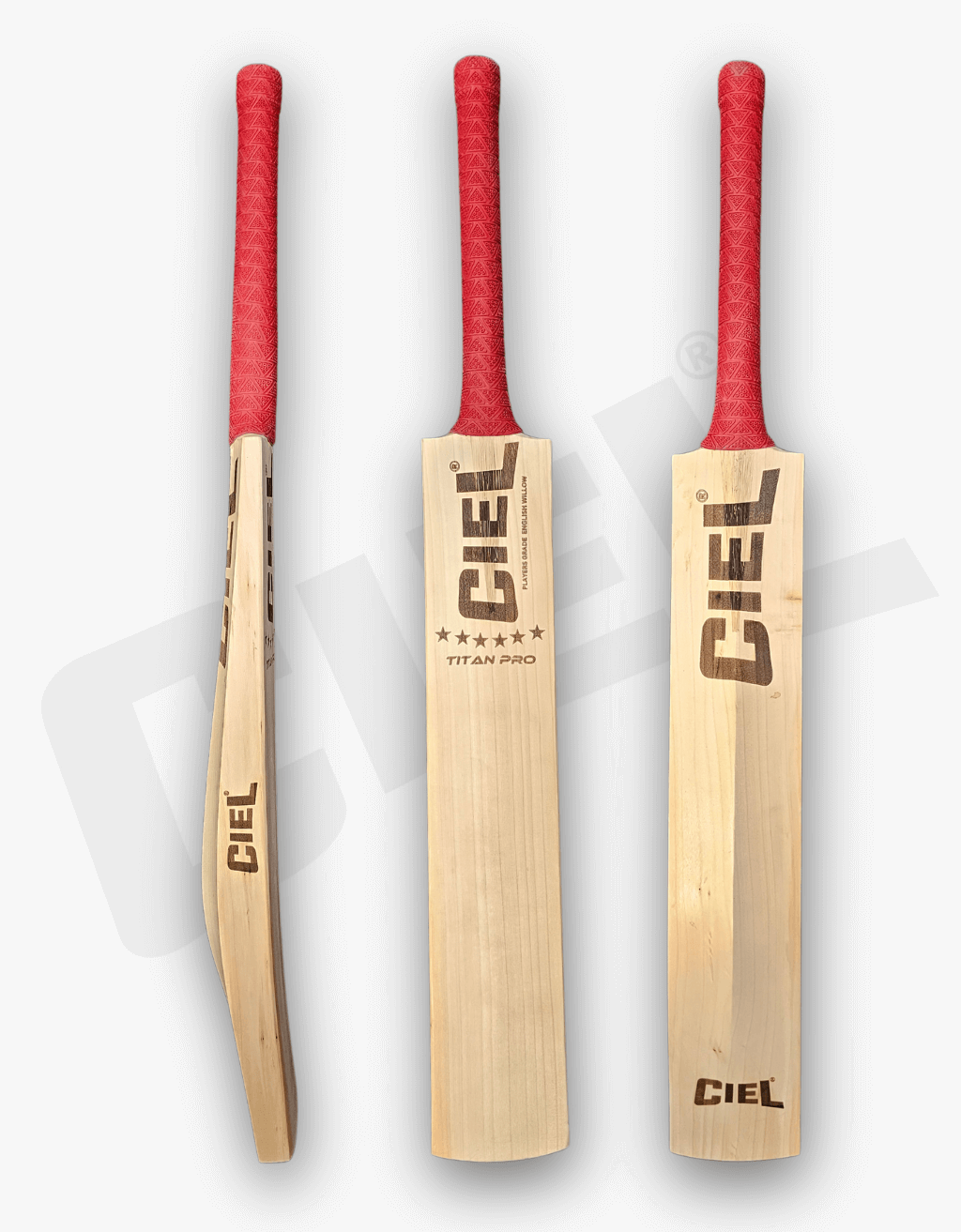
| Player Grade | Titan Pro | 8–12 | 40–42mm | ₹49,999 |
| Ultra Premium | Reserve Edition | 9–15 | 41–43mm | ₹59,999 |
Entry Level — Surge
4–5 grains · 38–40mm edges · ₹7,999
A genuine English willow cleft at the start of the range. Fewer grains means younger timber, which is denser and more forgiving of abuse — a real advantage on rough grounds.
Right for: A first English willow bat, or a second bat for nets.
Development — Torrent
5–7 grains · 39–41mm edges · ₹12,999
More maturity in the cleft and a cleaner run of fibre through the blade than the Surge.
Right for: A player moving up from Kashmir willow into regular leather ball cricket.
Club Grade — Vortex
5–7 grains · 40–42mm edges · ₹16,999
The same blade dimensions as bats costing twice as much. The difference above this point is cleft selection, not size.
Right for: Social and occasional club cricket. Honestly, most club cricketers stop here and should.
Grade 1 — Striker
6–7 grains · 40–42mm edges · ₹20,999
Genuine Grade 1: a mature cleft with straight fibre running cleanly from toe to shoulder, even density and no internal cracking. This is where response becomes noticeably more consistent across the full face.
Right for: Regular league cricket. The first grade where you can feel what you paid for.
Grade 1 Power — Inferno
6–7 grains · 42mm+ edges · ₹23,999
The same Grade 1 cleft as the Striker, differentiated by geometry rather than timber — a fixed full profile with no concaving at all, so every gram stays in the blade.
Right for: Grade 1 timber with maximum mass. 1220g minimum, five adult sizes only.
Grade 1+ — Dominator
7–9 grains · 40–42mm edges · ₹36,999
A more mature cleft than Grade 1, with straighter fibre and more even density from toe to shoulder. Our most-chosen English willow bat.
Right for: Serious league, district and representative cricket.
Grade 1+ Limited — Apex Limited
8–10 grains · 42mm+ edges · ₹42,999
Grade 1+ selection in the same no-concaving full profile as the Inferno. Mass and cleft quality together.
Right for: Power hitters who want a premium cleft without giving up blade mass.
Player Grade — Titan Pro
8–12 grains · 40–42mm edges · ₹49,999
The top selection of our English willow, chosen for uniform density across the entire blade rather than for grain count alone.
Right for: Representative and professional-level cricket, where consistency of response matters every ball.
Ultra Premium — Reserve Edition
9–15 grains · 41–43mm edges · ₹59,999
The finest clefts we see, and genuinely rare. Needs ten to twelve hours of knocking in because a finer cleft has more surface to consolidate.
Right for: A bat for someone who wants the best cleft available and will prepare it properly.
What does not change with grade
Worth stating plainly, because it is where a lot of buyers assume a ladder exists that does not.
| Specification | Surge ₹7,999 | Reserve Edition ₹59,999 |
|---|---|---|
| Pressing | 8-stage hydraulic | 8-stage hydraulic |
| Handle | Sarawak cane, multi-piece | Sarawak cane, multi-piece |
| Toe guard | Reinforced, fitted | Reinforced, fitted |
| Profile choice | All five, free | All five, free |
| Handle shape & toe shape | Your choice, free | Your choice, free |
| Laser engraving | Free | Free |
| Warranty | 12-month handle | 12-month handle |
| What changes | The cleft. Only the cleft. | |
Higher grade does not mean longer lasting
This surprises people, and it is the opposite of what the price suggests.
Higher grades are selected for performance, not durability. A finer cleft is older, lighter and less dense — which produces superb rebound and a more consistent face, but also a bat with less material to absorb repeated abuse.
On a rough club ground with abrasive pitches and hard grounds, a lower grade will frequently survive longer. It is denser, there is more of it, and it is more forgiving of the contact that a club cricketer actually makes.
What genuinely decides how long a bat lasts is not the grade at all. It is whether it was knocked in properly and how it is stored. A ₹59,999 bat that skipped preparation will fail before a ₹7,999 one that did not.
Which grade your cricket justifies
| You play | Sensible grade | Our bat |
|---|---|---|
| Social, occasional, weekend | Entry to Club Grade | Surge ₹7,999 · Torrent ₹12,999 · Vortex ₹16,999 |
| Regular league cricket | Grade 1 | Striker ₹20,999 · Inferno ₹23,999 |
| Serious league, district | Grade 1+ | Dominator ₹36,999 · Apex Limited ₹42,999 |
| Representative, professional | Player Grade and above | Titan Pro ₹49,999 · Reserve ₹59,999 |
| Academy, four nets a week | Density over grade | Academy Edition Kashmir ₹4,499 |
Our honest advice: if you play social or occasional club cricket, the Vortex at ₹16,999 has the same blade dimensions as bats costing twice as much and will serve you just as well. Grade 1 and above starts to earn its price when you play regular competitive cricket and need consistent response across the full face, every ball.
We would rather tell you that than sell you a grade you do not need. A player with a bat they can control beats a player with a bat they cannot.
Grade matters less than profile
Worth saying in an article about grades. Profile decides where your sweet spot sits and how the bat picks up — which changes how the bat plays far more than the cleft does. Grade affects consistency and longevity. The correct profile in a lower grade will suit you better than the wrong profile in a higher one, which is why profile is free on every bat we make. Our guide to bat profiles covers all five.
Kashmir willow is graded differently
Applying English willow language to Kashmir willow is where a lot of misleading marketing comes from.
Kashmir willow is naturally denser with less pronounced grain, so grain count matters far less — a Kashmir bat sold on grain count is being sold on the wrong number entirely. Our graders check fibre straightness, density evenness from toe to shoulder, absence of soft patches and moisture content.
And names are not grades. Some sellers market top-grade Kashmir willow as “Signature Willow” or “Nurtured Willow” and price it above ₹12,000. It is the same grade we call Player Grade and sell at ₹5,999. The name on the sticker is not what makes a bat expensive — the number of hands it passes through is.
Our full Kashmir willow range runs from ₹4,499, and there is a direct comparison in Kashmir willow vs English willow.
Questions players ask
What is the difference between Grade 1, Grade 1+ and Player Grade English willow? +
They describe the cleft the bat was cut from, not the workmanship. Grade 1 is a mature cleft with straight fibre running cleanly through the blade, typically 6 to 7 grains. Grade 1+ is a more mature cleft with straighter fibre and more even density, typically 7 to 10 grains. Player Grade is the top selection, chosen for uniform density across the whole blade, typically 8 to 12 grains. The pressing, the handle, the toe guard and the warranty are identical across all three.
Is a higher grade cricket bat better? +
It is a better cleft, which is not the same as a better bat for you. Higher grades give more consistent response across the face and tend to stay good longer. But a higher grade is also lighter and less dense, which makes it less tolerant of abuse on rough grounds. A Grade 2 Kashmir willow bat will frequently outlast a Grade 1+ English willow bat in heavy net use. Buy the grade your cricket justifies.
Does more grains mean a better cricket bat? +
No, and this is the most persistent myth in bat buying. Grains record growing seasons, so a higher count means older timber - but a straight-grained seven-grain cleft will outperform a wandering twelve-grain one every time. Straightness beats count. Grain run-out at the edges, where fibres angle out of the blade rather than running through it, is the failure nobody talks about and it is invisible to most buyers.
Is English willow grading based on appearance? +
Appearance correlates with quality but it is not the thing being graded. What our graders check is fibre straightness through the blade, evenness of density from toe to shoulder, moisture content, absence of internal cracking or soft patches, and how cleanly the cleft came out of the press. A cosmetically clean face usually indicates a well-matured cleft, but it can also indicate bleaching or heavy sanding, which is why we do not grade on looks alone.
Why does my English willow bat have marks and specks? +
Because it is a natural material. Genuine English willow carries character - specks, colour variation, butterfly stain and mineral streaks are all normal and none of them affect performance. A face with no marks at all should make you curious rather than pleased, because it has often been bleached or heavily sanded to look that way.
What is butterfly stain on a cricket bat? +
A natural discolouration in the willow, usually a reddish or brown marking, caused by mineral deposits taken up by the tree as it grew. It is entirely cosmetic and has no effect on how the bat plays or how long it lasts. Some sellers price butterfly-stained clefts lower simply because they look unusual, which can make them good value.
Does grade affect how long a bat lasts? +
Yes, but not in the direction most people assume. Higher grades are selected for performance rather than durability, and finer clefts are lighter and less dense. On a rough club ground with abrasive pitches, a lower grade will often survive longer. What genuinely decides lifespan is whether the bat was knocked in properly and how it is stored.
Is grade more important than profile? +
For how a bat feels and plays, profile matters more. Grade describes the cleft and affects consistency of response and longevity. Profile decides where your sweet spot sits and how the bat picks up. The correct profile in a lower grade will suit you better than the wrong profile in a higher one, which is why we include profile choice free on every bat.
What grade should a club cricketer buy? +
Grade 1 or below for most club cricketers. If you play social or occasional cricket, our Vortex at ₹16,999 has the same dimensions as bats costing twice as much and will serve you just as well. Grade 1 and above starts to earn its price when you play regular league, district or representative cricket, where a straighter and more mature cleft gives more consistent response across the full face.
Is Kashmir willow graded the same way? +
No, and applying English willow language to Kashmir willow is where a lot of misleading marketing comes from. Kashmir willow is naturally denser with less pronounced grain, so grain count matters far less. Our graders check fibre straightness, density evenness from toe to shoulder, absence of soft patches and moisture content. A Kashmir bat sold on grain count is being sold on the wrong number.
Do higher grade bats need more knocking in? +
Broadly yes, because finer clefts have more work to do to consolidate the surface. Our English willow bats need six to eight hours, the full-profile Inferno and Apex Limited need eight to ten, and the Reserve Edition needs ten to twelve. All of ours need less than most because every bat passes through 8 hydraulic press stages before it ships.
Does a higher grade cost more because it performs better? +
Partly. A more mature, straighter cleft is genuinely rarer, and rarity is most of the price difference. The rest is supply chain. When you buy direct from a manufacturer you pay for the cleft; when you buy through a distributor, a wholesaler and a retailer you pay for the cleft plus three margins.
Decided on a grade? Build the rest of the specification — profile, handle, toe, size, weight and engraving, all free — on our custom bat builder, or see the full English willow range.
Made in Meerut · Built to order
Nine grades. One standard of workmanship.
₹7,999 to ₹59,999 · 8-stage hydraulic pressing on every bat · Five profiles, three handle shapes, seven sizes, your exact weight, laser engraving — all free · 12-month handle warranty · Free shipping across India