
Cricket Bat Grains ExplainedWhat the count means, what it does not, and why straightness beats it every time
Grain count is the number buyers ask about most and the one that misleads most often. It is not meaningless — but it is a rough indicator of something, not a specification, and treating it as a score is how people end up with the wrong bat.
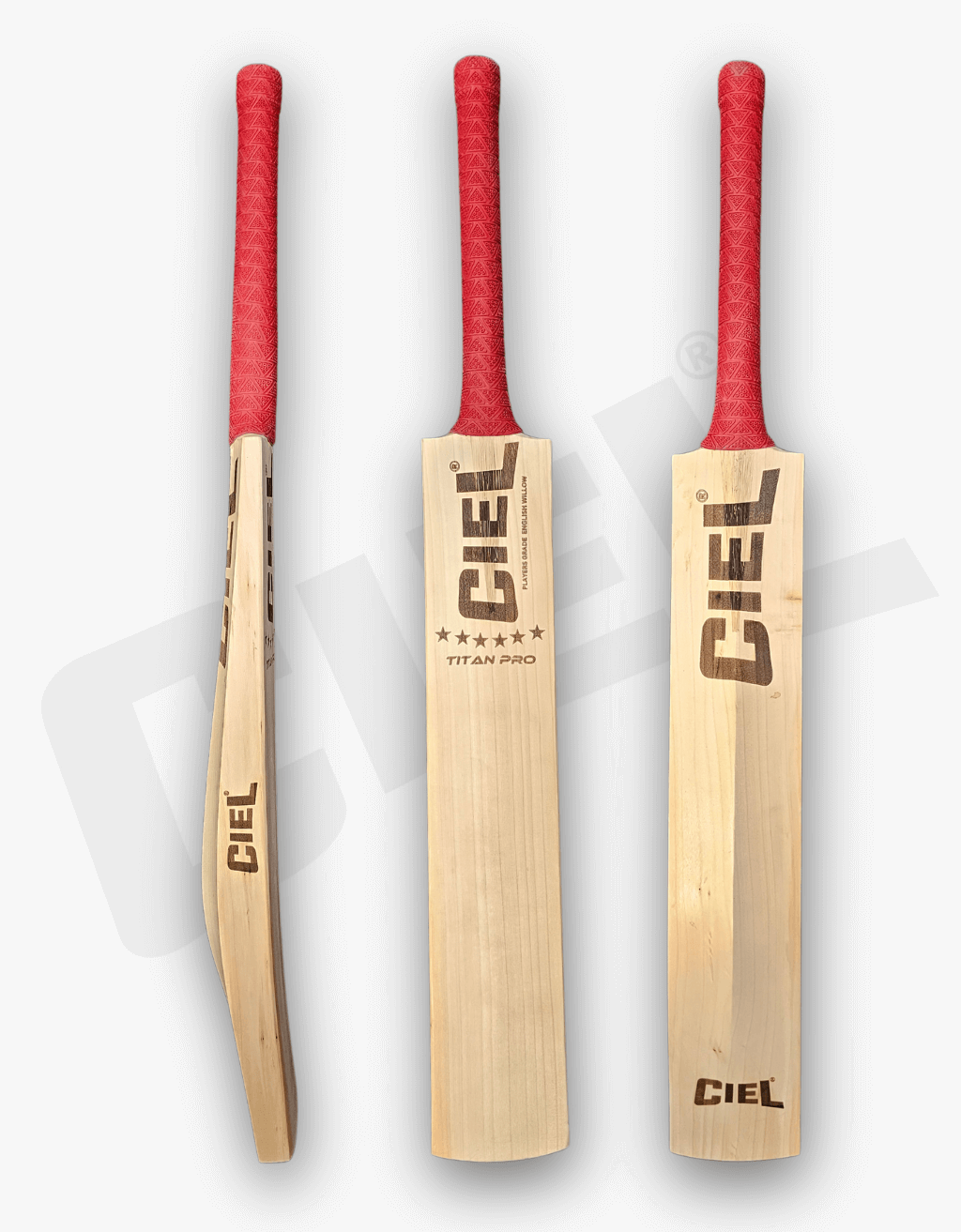
What a grain actually is
A willow tree lays down one growth ring a year. When a cleft is cut from the trunk, those rings show on the face of the blade as vertical lines running from toe to shoulder.
So counting grains is counting growing seasons. A bat showing eight grains was cut from timber that grew through at least eight seasons in that section of trunk.
That is the whole of it. Everything else people attach to grain count is inference from that one fact — some of it reasonable, some of it not.
What a higher count means
More rings in the same width of blade means the tree grew more slowly in that section — tighter rings, denser packing of growing seasons.
Slower-grown willow tends to be more mature and better structured, which correlates loosely with better performance. That correlation is real, and it is why grain count became a proxy for grade in the first place.
But a correlation is not a measurement. Grain count tells you something about how the timber grew. It tells you nothing about how straight the fibres run, how evenly dense the cleft is, whether there are soft patches inside it, or how many times it was pressed — and each of those matters more.
Why straightness beats count
This is the single most useful idea in the article.
A straight-grained seven-grain cleft will outperform a wandering twelve-grain one every time.
The reason is structural. The fibres in willow run along the blade, and they are what carry load when a ball strikes the face. Fibres running cleanly from toe to shoulder distribute that load along their length. Fibres that wander, angle or curve are carrying the same load across themselves rather than along themselves, which is the weaker direction.
So when you look at a bat face, the useful question is not how many lines are there — it is do those lines run straight and parallel down the blade, or do they wander?
Straight, evenly spaced, parallel lines are a better sign than a high count with irregular spacing. And you cannot count your way to that judgement, which is precisely why grain count is the number sellers lead with.
Grain run-out
The one to know about, because it is a genuine structural weakness that is close to invisible.
Grain run-out is where the fibres angle out of the blade at the edge rather than running through it. Instead of the grain continuing down the face and out at the toe, it exits sideways.
That leaves the edge without continuous fibre support. It is one of the first things our graders check at the cleft stage — and it is one of the last things a buyer thinks to look for, because on a finished bat face you would have to know to look at the edges rather than the middle.
It is also not something a photograph shows reliably. Which is worth remembering the next time a listing shows you a close-up of the face and quotes a number.
More grains can mean less durable
The genuinely counterintuitive part, and the reason buying up on grain count can backfire.
Higher grain counts come from older, slower-grown timber — which is lighter and less dense for its dimensions. Superb rebound, excellent response, and less material there to absorb repeated abuse.
| Higher grain count | Lower grain count | |
|---|---|---|
| Timber | Older, slower grown | Younger, faster grown |
| Density | Lower | Higher |
| Response | More consistent | Less consistent |
| Tolerance of abuse | Lower | Higher |
| Suits | Players middling the ball regularly | Developing players, high-volume nets |
On a rough Indian club ground, a lower-count bat frequently outlasts a higher-count one costing several times more. That is not a fault — it is what happens when timber selected for response is asked to survive instead.
Which is why we would point an academy player at a denser, lower-grade bat rather than a finer one. Our piece on value goes into it properly.
Grains on Kashmir willow
Short section, because the answer is short: grain count means very little on Kashmir willow.
Kashmir willow is naturally denser with less pronounced grain than English willow. The lines you can count on the face tell you very little about the cleft behind them, because the relationship between ring spacing and performance that holds loosely in English willow largely does not hold here.
A Kashmir willow bat sold on grain count is being sold on the wrong number — usually by someone applying English willow language to a different timber, either through habit or because the number sounds impressive.
What a grader actually checks on Kashmir willow is fibre straightness, density evenness toe to shoulder, absence of soft patches, and moisture content. Our Player Grade explainer covers all four.
The marks on a bat face
Willow is a natural material and it carries evidence of having been a tree. Almost none of it matters.
Butterfly stain
A reddish-brown marking, often spreading in a wing shape across the blade.
What it means: Minerals the tree took up as it grew. Entirely cosmetic — it has no effect on performance and a butterfly-stained cleft is graded on the same four criteria as any other.
Specks and pin knots
Small dark points scattered on the face.
What it means: Where tiny branches or buds formed. Cosmetic in almost every case. A grader only rejects them if they sit in a cluster where the blade needs to be strongest.
Mineral streaks
Thin darker lines running with or across the grain.
What it means: Same cause as butterfly stain, less spread out. No effect on how the bat plays.
Colour variation
One part of the blade lighter or darker than another.
What it means: Willow is a natural material and clefts are not uniform. A face with no variation at all has often been bleached, which should make you more curious rather than less.
The one to be suspicious of is the absence of marks. A completely uniform, unblemished face has often been bleached or heavily sanded — and heavy sanding removes material from a blade that was pressed to a specific thickness.
Our bats by grain count
Ranges rather than fixed figures, because we grade the cleft first and the count falls where it falls. A maker quoting one exact number across a whole model is quoting a target, not a measurement.
| Bat | Grains | Price |
|---|---|---|
| Surge | 4–5 | ₹7,999 |
| Torrent | 5–7 | ₹12,999 |
| Vortex | 5–7 | ₹16,999 |
| Striker | 6–7 | ₹20,999 |
| Inferno | 6–8 | ₹23,999 |
| Dominator | 7–9 | ₹36,999 |
| Apex Limited | 8–10 | ₹42,999 |
| Titan Pro | 8–12 | ₹49,999 |
| Reserve Edition | 9–15 | ₹59,999 |
Two things worth reading off that table. The range overlaps — a Torrent and a Vortex can both show six grains, and the difference between them is in the properties you cannot count. And the count rises with price because both follow grade, not because we are selling lines on a face.
Choose by size, weight and profile first. Those decide whether you can actually use the bat. Then buy the grade your cricket justifies. Grain count is a rough indicator of that grade — useful context, and the number most likely to talk you into the wrong bat if you treat it as a score.
Questions buyers ask
What are grains on a cricket bat? +
The vertical lines running down the face. Each one is a growing season - a willow tree lays down a ring a year, and when a cleft is cut those rings show as straight lines on the blade. So a bat with eight grains was cut from timber that grew through at least eight seasons in that section.
Is a higher grain count better? +
Not on its own, and this is the most over-weighted number in bat buying. More grains means older, slower-grown timber, which correlates loosely with better performance. But a straight-grained seven-grain cleft will outperform a wandering twelve-grain one every time, and straightness is not something you can count.
How many grains should a good cricket bat have? +
Between about five and twelve covers almost every sensible English willow bat. Ours run from four to five on the Surge up to nine to fifteen on the Reserve Edition. Anywhere in that range can be an excellent bat - what matters more is whether the fibres run straight through the blade.
Do more grains mean a bat lasts longer? +
Usually the opposite. Higher grain counts come from older, slower-grown timber that is lighter and less dense - superb response, and less material to absorb repeated abuse. A lower-count bat is often more durable, which is why they suit developing players and high-volume net cricket better.
What is grain run-out? +
Where the fibres angle out of the blade at the edge rather than running cleanly through it. It is a structural weakness and it is close to invisible from the face, which is why it is one of the first things a grader checks and one of the last things a buyer thinks to look for.
Do grains matter on Kashmir willow? +
Very little. Kashmir willow is naturally denser with less pronounced grain, so the lines you can count tell you almost nothing about the cleft. A Kashmir willow bat sold on grain count is being sold on the wrong number, usually by someone applying English willow language to a different timber.
What is butterfly stain on a cricket bat? +
A reddish-brown marking, often spreading in a wing shape, caused by minerals the tree took up as it grew. It is entirely cosmetic and has no effect on performance. A butterfly-stained cleft is graded on the same criteria as any other.
Are specks and marks on a cricket bat a defect? +
Almost never. Specks, pin knots, mineral streaks and colour variation are all normal in a natural material. A grader only rejects them where they cluster in a part of the blade that needs to be strongest. A face with no marks at all is more suspicious than one with a few.
Can I judge a bat from a photograph of its grains? +
Only partly, and less than you would hope. You can count the lines and see roughly how straight they are on the face. You cannot see grain run-out at the edges, density evenness from toe to shoulder, moisture content at pressing, or how many press stages it had - and those decide more than the count does.
What should I ask instead of the grain count? +
How many pressing stages, and what the maker grades a cleft on. A maker describes fibre straightness, density evenness, moisture content and soft patches. A reseller gives you a number and a brand name. Those two answers tell you far more than counting lines in a photograph.
How many grains do your bats have? +
Four to five on the Surge at ₹7,999, rising to nine to fifteen on the Reserve Edition at ₹59,999. They are ranges rather than fixed figures because willow is a natural material - we grade the cleft first and the count falls where it falls.
Should I choose a bat by grain count? +
No. Choose by size, weight and profile first - those decide whether you can actually use the bat. Then buy the grade your cricket justifies. Grain count is a rough indicator of grade, not a specification worth optimising, and it is the number most likely to talk you into the wrong bat.
Related: what the grades describe, why stickers tell you nothing, and the profile guide — which changes how a bat plays more than any of this.
Made in Meerut · Graded at the cleft
We grade the timber. The grains follow.
Nine English willow bats ₹7,999–₹59,999 · Kashmir willow from ₹4,499 · Same 8-stage pressing, cane handle, toe guard and 12-month warranty on every one · Profile, handle shape, toe shape, size, weight and engraving all free