English Willow Bat Grades Explained: Grade 1, Grade 1+ and Player Grade

Technical Guide Blog #09 — The 2026 Series Read Before You Buy By Ciel Sports, Meerut · April 2026 · 15 min read

English Willow Bat Grades Explained: Grade 1, Grade 1+ and Player Grade

Every player buying an English willow bat eventually confronts the grade system — and most of them are confused by it. Grade 1 is the best? Then why is there a "Grade 1+" and a "Player Grade" that costs more? Why does one brand's Grade 2 look identical to another brand's Grade 1? And why does every guide say "grades are mainly cosmetic" but then charge you Rs.18,000 more for the higher one? At Ciel Sports, we grade willow clefts every day at our Meerut factory. This is the complete technical answer — what grades actually measure, what they do not measure, and exactly how to read a bat's grade yourself just by looking at it.

🏭
The single most important thing in this guide: English willow grades measure cosmetic quality — how the wood looks. They do not directly measure performance — how the bat plays. A Grade 1 bat from a manufacturer who presses well and seasons properly will outperform a Player Grade bat from a manufacturer who cuts corners on manufacturing. This is not a disclaimer. It is the central truth of bat grading that most guides never say clearly enough.
English willow bat grades explained — Ciel Sports Titan Pro Player Grade English willow bat showing 8 or 8+ perfectly straight grain lines Meerut manufacturer
The Ciel Sports Titan Pro — Player Grade English Willow. 8 or 8+ perfectly straight grains, blemish-free face, lowest density clefts available. | Shop Titan Pro Rs.39,999 →

1. What English willow grades actually measure — and what they do not

To understand bat grading correctly, you need to understand what is being graded — and what is not.

Grades measure the cosmetic quality of the raw willow cleft. A cleft inspector — either at the willow merchant's warehouse in England or at the bat manufacturer's factory in Meerut — looks at the cleft and assesses: how many grains does it have, how straight are those grains, what blemishes are on the face, how much heartwood is present, and how consistent is the colouration. Based on those visual observations, the cleft receives a grade. Higher grade = better-looking cleft.

Grades do not directly measure performance. They do not measure:

  • How hard or soft the willow fibre structure is
  • How much the bat will ping when struck with a leather ball
  • How large the effective sweet spot will be
  • How long the bat will maintain peak performance
  • How well the bat has been pressed, seasoned, or shaped

Performance is determined by the combination of the wood quality (partially correlated with grade) and the manufacturing process (not at all described by grade). Two bats of the same grade from two different manufacturers will play completely differently because of differences in pressing stages, seasoning duration, and shaping precision.

⚠ The willow merchant's verdict on grading

The world's leading English willow merchants are explicit on this point: "A Grade 1 is the best looking blade, though it will not necessarily play the best." This confirms what every experienced bat maker knows — grade describes appearance, not performance. Choosing a bat by grade alone, without considering the manufacturer's pressing and seasoning process, is like choosing a restaurant by how clean the menu looks.

2. Why there is no universal grading standard — the truth the industry hides

Here is the thing that the cricket equipment industry never clearly communicates to buyers: there is no universal, independently verified standard for English willow bat grading.

There is no ICC certification. There is no MCC grading body. There is no independent testing laboratory that assesses willow grades. English willow merchants publish rough grading guidelines, but these are advisory — not binding on any manufacturer. Every company that sells a bat with a grade label on it has defined that grade themselves, using their own criteria, applied by their own cleft assessors.

The practical consequence: one brand's "Grade 1+" may be another brand's "Grade 2." A retailer selling bats they sourced from a factory in Meerut cannot verify what grade the cleft actually was — they know only what the label says. A bat sold as "Player Grade" by a brand that outsources manufacturing has a Player Grade label on a bat whose actual cleft selection they were not present to observe.

0
Universal grading bodies for English willow
75%+
World's cricket bat willow sourced from England's specialist growers
100%
Of Ciel Sports grades set at our Meerut factory
💡 What this means when buying from Ciel Sports

At Ciel Sports, we source English willow clefts from specialist willow merchants and re-grade every cleft ourselves at our Meerut factory — before a single cut is made. Our Grade 1, Grade 1+, and Player Grade labels reflect our own cleft assessors' evaluation of the specific piece of wood that went into your bat. We are the manufacturer. We are present at the grading. When we tell you a bat is Player Grade, we mean the specific cleft it was made from met our Player Grade criteria at the moment of inspection. This is what factory-direct means for bat grading — not just for price.

3. The 5 criteria used to grade every English willow cleft

While there is no universal standard, the criteria used across the industry are broadly consistent. Here is how we assess every cleft at Ciel Sports — and how most serious manufacturers assess theirs.

Criteria What we look for Higher grade Lower grade
Grain count Number of vertical grain lines running face of cleft More grains (6+, 8+, 10+) Fewer grains (4–5)
Grain straightness Whether grains run perfectly vertical shoulder to toe Perfectly straight, parallel Curved, converging, angled
Face cleanliness Presence of specks, knots, stains, discolouration Blemish-free or minimal marks Visible blemishes, staining
Heartwood ratio Amount of reddish inner wood visible at edges Minimal or no heartwood Significant heartwood (30%+)
Cleft density Weight relative to size — lighter = lower density = better Light cleft, lower density Heavy cleft, higher density

Of these five criteria, grain count and straightness are the most visible to a buyer looking at a bat. Face cleanliness is also immediately visible. Heartwood requires looking at the edge of the bat. Density cannot be assessed visually — it requires handling the bat and knowing the cleft's weight before it was shaped.

4. Grains — the most visible signal, and the most misunderstood

The grain lines on the face of a cricket bat are the single most discussed aspect of bat grading — and the most consistently misunderstood. Here is the complete picture.

What grains actually are

Grain lines are the annual growth rings of the willow tree, visible on the face of the bat where the cleft has been split. Each grain line represents one year of tree growth. A bat with 10 grains was made from a cleft where approximately 10 years of growth rings are visible on the face — which means the cleft came from an older, more mature section of the tree's trunk.

What more grains indicate

More grains generally mean older, more mature willow with tighter, more closely-spaced growth rings. This typically indicates:

  • Better initial ping: Older, denser outer wood tends to respond more elastically under ball impact from earlier in the bat's life
  • Larger initial sweet spot: Tighter grain structure means more consistent fibre density across the face
  • Potentially shorter peak lifespan: Very fine-grained willow can reach its performance peak faster but may not sustain it as long as coarser willow

What fewer grains indicate

Fewer grains (4–6) mean younger willow with wider, more widely-spaced growth rings. This typically indicates:

  • Slower development: The bat may need more knock-in time before reaching full performance
  • Longer lifespan: Wider-grained willow is more robust and tends to maintain performance longer
  • Lower grade classification: Regardless of performance potential, fewer grains = lower visual grade
✅ The Chase Cricket insight on grains — from the source

Chase Cricket — one of England's most respected bat makers — states this clearly on their grading page: "Cricket bats with more grains tend to perform better initially but may not last as long. Younger English willow that has fewer grains may need more time to reach this same peak performance level, however they tend to have a longer life span." This is the honest picture: more grains does not mean permanently better. It means better sooner, but possibly not for longer.

The grain straightness factor — more important than grain count

If you can only assess one thing about a bat's grains, assess straightness — not count. Grains that travel perfectly vertically from shoulder to toe indicate the cleft was split correctly along the wood's natural fibre direction. These bats have consistent response across the entire face. Grains that curve, angle, or converge indicate the cleft was cut off-axis — meaning different zones of the face have different fibre orientations and respond differently under impact. An 8-grain bat with curved grains will perform less consistently than a 6-grain bat with perfectly straight grains.

Grade 1
6 or 6+
Grade 1+
7 or 7+
Player Grade
8 or 8+

5. Grade 1 English Willow — fully explained

Grade 1 · Top 10–15% of English willow clefts
Grade 1 English Willow
Excellent performance · Ideal entry into English willow · Ciel Sports Striker — Rs.21,999
Grain count
6 or 6+ straight grains
Face appearance
Good face — minor discolouration possible
Heartwood
Minimal — may have small edge presence
Density
Good — lighter than Grade 2 and below
Blemishes
Minor cosmetic marks acceptable
Ciel Sports bat
Striker — Rs.21,999

What Grade 1 actually means in practice

Grade 1 is the entry point to what serious bat manufacturers consider premium English willow. It represents the top 10–15% of all English willow clefts assessed by the merchant — clefts with clean, predominantly straight grains, minimal blemishes, and acceptable heartwood presence. These are not the finest clefts available, but they are genuinely good pieces of wood that will deliver excellent leather ball performance when correctly pressed and shaped.

The minor discolouration and cosmetic marks that may be present on a Grade 1 face have no effect on the bat's performance. They are the reason this cleft is Grade 1 rather than Grade 1+. Nothing more. A Grade 1 bat that has been 8-stage pressed, properly seasoned, and hand-shaped will outperform any brand's Grade 1+ or Player Grade bat that has been factory-line manufactured with 2-stage pressing.

✓ What you will see on the face
  • 6 or more vertical grain lines
  • Generally straight grains from shoulder to toe
  • Clean cream or light straw colour across most of the face
  • Possible faint specks or very minor surface marks
  • Possible slight discolouration at edges — purely cosmetic
✗ What you will not see on a genuine Grade 1
  • Prominent knots in the hitting zone
  • Large butterfly stains across the face
  • Heavy heartwood across more than 20% of the blade
  • Grains that curve significantly across the face
  • Visible structural irregularities in the wood
Shop Striker — Grade 1 — Rs.21,999 →

6. Grade 1+ English Willow — fully explained

Grade 1+ · Top 5–10% of English willow clefts
Grade 1+ English Willow
Elite performance · Our most popular bat · Ciel Sports Dominator — Rs.34,999
Grain count
7 or 7+ straight grains
Face appearance
Very clean — only very minor cosmetic marks
Heartwood
Very minimal — edge only if present
Density
Low — lighter pickup for weight
Blemishes
1–2 very minor marks only — edge or shoulder
Ciel Sports bat
Dominator — Rs.34,999

What Grade 1+ actually means in practice

Grade 1+ sits in the sweet spot between accessibility and the absolute pinnacle. These clefts have been selected for both their cosmetic quality and their performance characteristics — they typically show 7 or more straight grains, a very clean face, minimal heartwood, and lower density than Grade 1 clefts. In many cases the performance difference between Grade 1+ and Player Grade in actual match conditions is genuinely marginal for most players.

The Grade 1+ label at Ciel Sports corresponds to clefts where our assessor found everything the same as Player Grade — excellent grain structure, low density, great weight-to-size ratio — but with one or two very minor cosmetic marks that prevent the cleft from meeting our blemish-free Player Grade standard. The wood quality is essentially equal. The aesthetics are very slightly below Player Grade. The price difference reflects rarity, not a significant performance gap.

✓ What you will see on the face
  • 7 or more straight, evenly-spaced grains
  • Very clean cream to white face
  • Possibly 1–2 very faint specks — barely visible
  • Very minimal heartwood at edges — if present at all
  • Consistent, even grain spacing face to toe
✗ What you will not see on a genuine Grade 1+
  • Any blemish in the main hitting zone
  • Uneven or inconsistent grain spacing
  • Heartwood across more than 10% of the blade face
  • Any grain curvature or deviation from vertical
  • Any structural marks or knots anywhere on the face
Shop Dominator — Grade 1+ — Rs.34,999 →
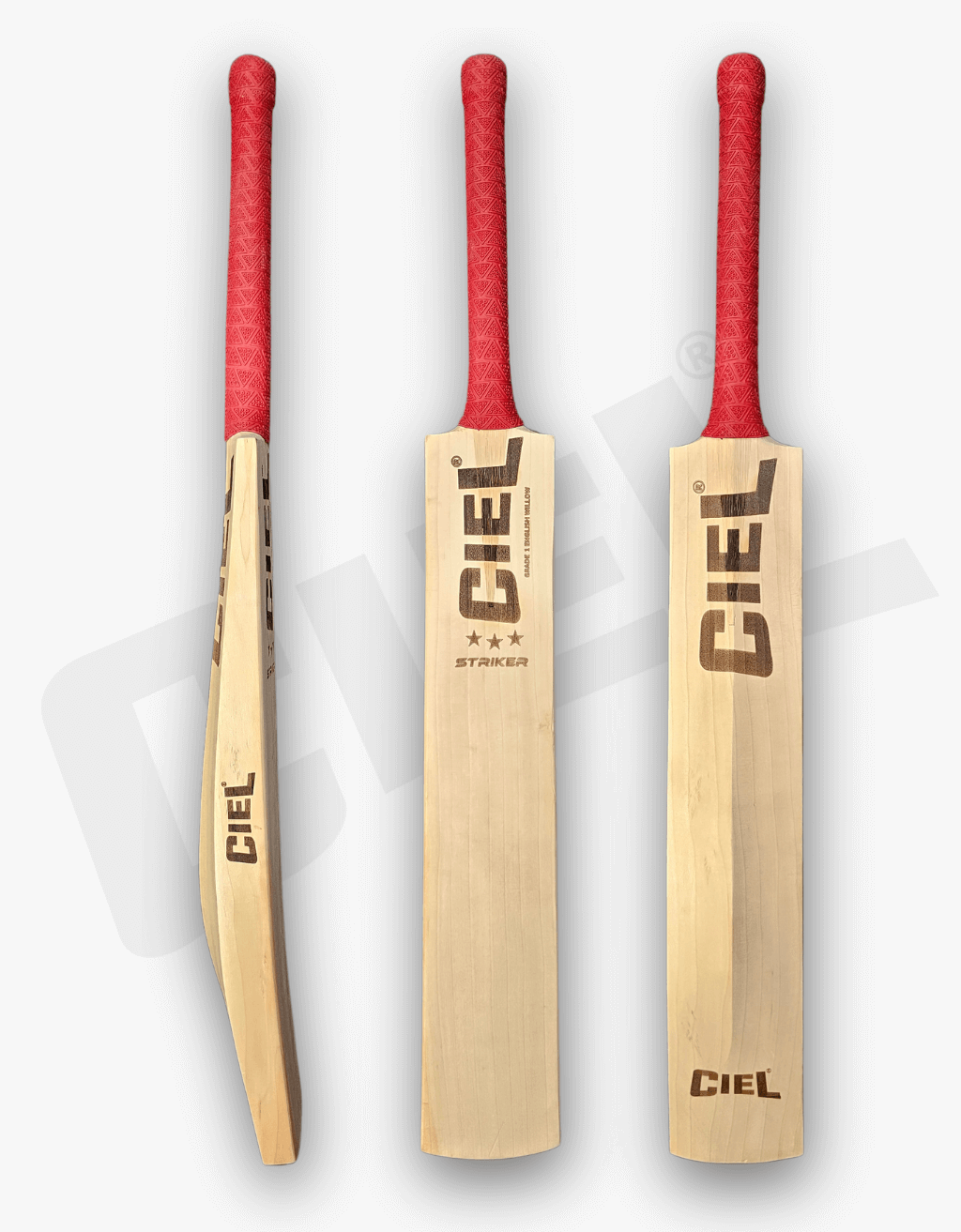
Ciel Sports Striker Grade 1 English willow bat face showing 6 or 6+ straight grains — grade 1 english willow appearance
Striker — Grade 1 · 6 or 6+ straight grains | Rs.21,999 →
Ciel Sports Dominator Grade 1+ English willow bat face showing 7 or 7+ straight grains — grade 1 plus english willow appearance
Dominator — Grade 1+ · 7 or 7+ straight grains | Rs.34,999 →

7. Player Grade English Willow — fully explained

Player Grade · Top 1–3% of English willow clefts
Player Grade English Willow
Professional standard · Top 1% of clefts · Ciel Sports Titan Pro — Rs.39,999
Grain count
8 or 8+ perfectly straight grains
Face appearance
Blemish-free — pristine, even cream colour
Heartwood
None visible or absolutely minimal trace only
Density
Lowest — lightest pickup for any given weight
Blemishes
Zero — no marks of any kind on the hitting face
Ciel Sports bat
Titan Pro — Rs.39,999

What Player Grade actually means in practice

Player Grade — also called Pro Grade or Limited Edition by some manufacturers — is the designation given to clefts that pass every quality criterion at the highest possible level. At Ciel Sports, Player Grade means: 8 or more perfectly straight grains, a completely blemish-free face, no visible heartwood, and a cleft density-to-size ratio that puts it in the lightest 1–3% of all clefts assessed that season.

These are genuinely rare pieces of wood. In a typical batch of 100 English willow clefts, perhaps 2–4 will meet Player Grade criteria as we define them. The rest become Grade 1+ and Grade 1 bats. Player Grade clefts typically come from older, more mature sections of the willow tree where the grain structure has fully developed — which is why the density is lower, the pickup is better, and the elastic response is more consistent across the entire face.

The Titan Pro is available with full bespoke specifications — profile, handle shape, weight preference, sweet spot position, and laser engraving. WhatsApp +91 95481 82993 to discuss your exact requirements before ordering.

✓ What you will see on the face
  • 8 or more perfectly straight, evenly-spaced grains
  • Clean, pristine cream-to-white face with no discolouration
  • No specks, no stains, no marks of any kind in the hitting zone
  • No visible heartwood on the edges
  • Consistent grain spacing from shoulder to toe — no variation
✗ What you will not see on genuine Player Grade
  • Any blemish anywhere on the face
  • Any heartwood on the edges
  • Any grain curvature — grains must be perfectly vertical
  • Any inconsistency in grain spacing
  • Any colour variation beyond natural cream-to-white tone
Shop Titan Pro — Player Grade — Rs.39,999 →
Ciel Sports Titan Pro Player Grade English willow bat face showing 8 or 8+ perfectly straight blemish-free grain lines — player grade english willow appearance
Titan Pro — Player Grade · 8 or 8+ perfectly straight grains · Blemish-free face · Top 1% of clefts. | Shop Titan Pro Rs.39,999 →

8. Full grade comparison — side by side

Criteria Grade 1 — Striker Grade 1+ — Dominator Player Grade — Titan Pro
Cleft rarity Top 10–15% Top 5–10% Top 1–3%
Grain count 6 or 6+ 7 or 7+ 8 or 8+
Grain straightness Good — straight Very good — very straight Perfect — precisely vertical
Face cleanliness Good — minor marks possible Very clean — 1–2 minor marks max Blemish-free — no marks
Heartwood Minimal — small edge presence Very minimal None visible
Cleft density Good Low Lowest available
Pickup feel Very good Excellent Outstanding
Pressing stages 8-stage 8-stage 8-stage
Hand shaped ✓ Yes ✓ Yes ✓ Yes
Bespoke options 5 profiles, 3 handles 5 profiles, 3 handles Full bespoke + laser engraving
Factory price Rs.21,999 Rs.34,999 Rs.39,999
Retail equivalent Rs.29,999+ Rs.39,999+ Rs.55,000+

"The most important observation: all three bats receive identical 8-stage pressing at our factory. The difference in grade is entirely in the cosmetic quality of the cleft. The manufacturing is the same. This is what factory-direct means — you pay for the wood, not the supply chain."

— Ciel Sports Manufacturing Team, Meerut

9. The blemish guide: what each mark means and whether it matters

Not all marks on an English willow bat face are equal. Some are purely cosmetic. Some are structural. Understanding the difference prevents buyers from rejecting perfectly good bats for the wrong reasons — and from accepting structurally compromised bats because they look clean.

Specks
Cosmetic only
Small dark dots caused by insect larvae boring into the bark during growth. Never reach the playing zone on high-grade clefts. Purely cosmetic — no performance impact whatsoever.
Butterfly Stain
Cosmetic only
Wing-shaped discolouration from frost pruning during tree growth. Very common on English willow. Purely cosmetic — often associated with denser, stronger wood. Does not affect performance.
Heartwood (Redwood)
Cosmetic — minor structural
Older inner wood — brownish-red band on edges. Small amounts: cosmetic only. Large amounts (30%+): can affect response zone consistency. Checked and limited at Ciel Sports Grade 1 and above.
Natural Discolouration
Cosmetic only
Variation in the cream-to-white colour of the willow face from natural soil conditions. Does not affect fibre structure or elastic response in any way.
Pin Knots
Cosmetic — check location
Tiny knots from small dormant branches. In the hitting zone: minor performance concern as the knot is denser than surrounding wood. Away from the hitting zone: purely cosmetic.
Large Knots
Structural concern
Prominent knots from larger branches — dense, hard zones that respond differently under impact. In the hitting zone these create inconsistent response. Should not appear on Grade 1 or above.
Curved Grains
Structural — performance impact
Grains that angle or curve across the face indicate the cleft was cut off-axis. Creates inconsistent fibre density across the blade — different zones respond differently. Avoid on any grade.
Surface Cracks
Structural — avoid
Hairline cracks running with or across the grain on a new bat indicate drying damage during manufacturing or transit. This is a manufacturing defect — should never appear on a new bat of any grade.
Blue Willow
Cosmetic only
Bluish hue from trees growing near mineral-rich soil. Unusual appearance but no performance impact. Some players specifically seek blue willow for its distinctive look.

10. How to read a bat's grade yourself — the 4-step face assessment

With the knowledge from this guide, you can now assess the approximate grade of any English willow bat yourself — whether you are in a shop, receiving a bat from online purchase, or evaluating a second-hand bat. Here is the exact process.

📋 4-step face assessment — do this in order

Step 1 — Count the grains. Look at the face from shoulder to toe. Count the vertical grain lines. Under 6 grains → Grade 2 or below. 6 or more → Grade 1 territory. 7 or more → Grade 1+ territory. 8 or more, evenly spaced → Player Grade territory. Remember: count is a starting point, not the whole story.

Step 2 — Check grain straightness. Run your eyes from the top of each grain to the bottom. Do they travel perfectly vertically without deviation? Or do they curve, converge, or angle across the face? Even a 10-grain bat with curved grains is not a premium bat. Straight grains matter more than grain count.

Step 3 — Assess face cleanliness. Look at the hitting zone — the central area from approximately 4 inches above the toe to 2 inches below the stickers. Are there any visible marks, specks, stains, or discolouration in this zone? Grade 1: minor marks possible at edges. Grade 1+: only 1–2 very faint marks, not in the hitting zone. Player Grade: nothing.

Step 4 — Check the edges for heartwood. Look at the side profile of the bat. Can you see a brownish-red band along one or both edges? A thin strip (5mm or less) at the edge is acceptable on Grade 1. On Grade 1+ and Player Grade it should be minimal or absent. A significant heartwood presence on a bat labelled Grade 1+ should be questioned.

11. Why manufacturing quality matters more than grade

We have said this twice already in this guide, and we will say it one final time — because it is genuinely the most important thing a buyer can take away from reading about bat grades.

A Grade 1 bat that has been:

  • Seasoned for 6–12 months at the correct moisture content
  • Pressed 8 stages with resting between each stage
  • Hand-shaped by a skilled craftsman who adjusted the profile to the individual cleft
  • Quality-checked with a mallet ping test before dispatch

...will outperform a Player Grade bat that has been:

  • Rush-seasoned in 6 weeks to reduce inventory time
  • Pressed twice on a factory production line
  • CNC-shaped to a standard template with no individual assessment
  • Visual-QC'd by someone who never picked it up and swung it

The grade describes the raw material. The manufacturer's process determines what that raw material becomes. Buying from a manufacturer who is transparent about their pressing stages, seasoning time, and quality control process is more important than chasing the highest grade label.

▶ YouTube — Ciel Sports: How to Choose Your English Willow Bat Profile
Once you know your grade, watch our founders explain the 5 profiles — so you choose the exact right bat for your playing style before ordering. Subscribe to Ciel Sports on YouTube →

12. Which grade should you buy?

🟢 Buy Grade 1 (Striker) if you are...
  • Buying your first genuine English willow bat
  • Upgrading from Kashmir willow for the first time
  • A club cricketer playing regular leather ball matches
  • An academy player at U-14, U-16 level
  • Budget-conscious but serious about leather ball performance
  • A player who values durability — fewer, wider grains last longer
  • A parent buying for a junior in Size 3 to Size 6
🔵 Buy Grade 1+ (Dominator) if you are...
  • A serious club, district, or competitive academy player
  • Playing multiple times per week
  • Someone who has used English willow before and knows their preferences
  • A player who wants the best performance-to-price ratio
  • Buying your primary match bat for a full season
  • Any player who cannot decide between Grade 1 and Player Grade
  • A player for whom aesthetics matter — cleaner bat face
⚫ Buy Player Grade (Titan Pro) if you are...
  • Playing district, state, or professional-level cricket
  • An aspiring professional or current U-19 standout
  • A player who notices the difference between Grade 1+ and Player Grade in the hands
  • Someone who wants full bespoke specs and laser engraving
  • A player for whom the bat is the single most important investment this season
  • Someone who wants the best available — and can appreciate the difference
Ciel Sports Striker Grade 1 English Willow bat
English willow · Grade 1 · 8-stage pressed
Striker — Grade 1 English Willow
6 or 6+ straight grains · 40mm edges · Hand shaped · Size 3 to Long Blade
Rs.21,999
View Striker →
Ciel Sports Dominator Grade 1+ English Willow bat
English willow · Grade 1+ · Most popular
Dominator — Grade 1+ English Willow
7 or 7+ straight grains · 40–45mm edges · Our most popular English willow bat
Rs.34,999
View Dominator →
Ciel Sports Titan Pro Player Grade English Willow bat
English willow · Player Grade · Full bespoke
Titan Pro — Player Grade English Willow
8 or 8+ straight grains · Blemish-free face · Top 1% clefts · Laser engraving
Rs.39,999
View Titan Pro →

13. Frequently asked questions — answered by the manufacturer

What do English willow cricket bat grades actually measure? +
Grades measure the cosmetic quality of the raw willow cleft — grain count and straightness, face cleanliness, heartwood presence, and cleft density. They do not directly measure performance. A Grade 1 bat from a manufacturer who presses 8 stages and seasons properly will outperform a Player Grade bat from a manufacturer who cuts corners on manufacturing. The grade describes the wood. The factory determines the performance.
Is there a universal standard for English willow bat grading? +
No — there is no universal, independently verified standard. No ICC certification, no MCC grading body. English willow merchants publish rough guidelines, but every manufacturer applies their own criteria. One brand's Grade 1+ may be another's Grade 2. When you buy from Ciel Sports, our grades are assessed by our own craftsmen at our Meerut factory — we are present at every grading decision.
Do more grains mean a better performing bat? +
Not automatically. More grains indicate older, more mature willow that tends to produce better initial ping and a larger sweet spot sooner. But fewer grains (wider grain) indicate younger willow that takes longer to reach peak performance but lasts longer once it gets there. For most club players, grain count affects aesthetics more than match performance. A correctly pressed 6-grain bat outperforms a poorly pressed 10-grain bat in every session.
What is a butterfly stain and does it affect performance? +
A butterfly stain is a natural wing-shaped discolouration caused by frost pruning during the tree's growth. It is purely cosmetic and has zero effect on performance or structural integrity. Bats with butterfly stains are often graded lower purely because of appearance — not because the wood is inferior. In fact, butterfly stains are frequently associated with denser, stronger wood.
Can a Grade 1 bat outperform a Player Grade bat? +
Yes — absolutely. Grade is a cosmetic description of the cleft. Performance depends on pressing stages, seasoning time, profile shaping, and quality control. A Ciel Sports Grade 1 Striker (8-stage pressed, hand-shaped, properly seasoned) will outperform a Player Grade bat from a manufacturer who presses twice and rushes seasoning. This is why who makes the bat matters as much as what grade it is.
What is heartwood and does it matter? +
Heartwood (redwood) is the older, inner wood of the willow tree that appears as a brownish-red band on the edges of the bat. Small amounts are cosmetic only. Large amounts (more than one-third of blade width) can create uneven response zones across the face. All Ciel Sports Grade 1 and above bats are assessed for minimal heartwood during cleft inspection — it is one of the five criteria we evaluate before any bat is made.
Is the Dominator (Grade 1+) worth Rs.13,000 more than the Striker (Grade 1)? +
For most serious club players — yes. The Grade 1+ clefts in the Dominator have more grains, a cleaner face, lower density, and marginally better initial performance than Grade 1. If you play multiple times per week and treat your bat as a serious investment — the Dominator is the right choice. If you are playing once a week or new to English willow — the Striker delivers excellent performance at Rs.13,000 less. Both are 8-stage pressed at the same factory. The difference is in the wood, not the manufacturing.

Every grade. Same factory. Direct to you.

Grade 1, Grade 1+ and Player Grade — all 8-stage pressed, hand-shaped, and quality-checked at our Meerut factory. No middlemen. No retail markup. Factory-direct to players in India and 50+ countries.

Back to blog