
Why Professionals Use English Willow Cricket Bats — The Science and the Standard
Every professional cricketer who has ever played Test cricket, ODI cricket or the IPL has used an English willow bat. Not occasionally — always. In over 150 years of professional cricket there has been no exception to this rule. The question is not whether English willow is the right material — it is, categorically and scientifically. The question worth answering is why. This guide explains the science, the history and what it means for every serious club cricketer choosing their next bat.
- What is English willow — the specific tree and why it matters
- The science — why English willow's cellular structure is unique
- The five physical properties that make English willow irreplaceable
- English willow vs every alternative — honest comparison
- How English willow became the professional standard
- Why Meerut makes 70% of the world's English willow bats
- What pressing does to English willow — and why it matters
- What this means for serious club cricketers
- Our English willow recommendations
- Frequently asked questions
What Is English Willow — The Specific Tree and Why It Matters
English willow used for cricket bats is a specific cultivated variety of white willow: Salix Alba Caerulea. The name means "blue-leafed white willow" — named for the slightly blue-green tinge on the underside of its leaves. It is not any willow tree. It is not willow grown anywhere in the world. It is a specific cultivated variety, grown primarily in Essex and Suffolk in England, on specific soil types, at specific planting densities, harvested at specific ages.
This specificity matters enormously. The properties that make English willow ideal for cricket bats are not generic to the willow family. They are specific to Salix Alba Caerulea grown in its native region under the right conditions. Willow of the same species grown elsewhere — in India, Australia or New Zealand — does not produce the same fibre characteristics. The soil chemistry, water table, climate and cultivation practices of the English growing regions produce a specific cellular structure that no other location has replicated consistently.
- Species: Salix Alba Caerulea — blue-leafed white willow
- Primary growing regions: Essex and Suffolk, England
- Harvest age: 12–18 years — the optimal age for cricket bat quality clefts
- Cultivation: Managed plantations with specific spacing, drainage and soil conditions
- Annual global production: Limited — approximately 40,000–60,000 quality clefts per year from the best growing regions
- Journey to Meerut: Clefts are rough-cut in England, dried, and shipped to Meerut where they are shaped, pressed and finished into bats
Every genuine English willow cricket bat — whether it carries a premium international brand name or is made and sold by Ciel Sports directly — uses clefts from this same limited supply. This is why English willow quality genuinely matters: the raw material is finite, specific and irreplaceable.
The Science — Why English Willow's Cellular Structure Is Unique
The performance of an English willow cricket bat is not a marketing claim. It is a measurable consequence of the wood's cellular structure. Understanding that structure explains every performance characteristic that makes English willow the professional standard.
The fibre architecture
Wood is made of millions of cells arranged in a specific structure. In most hardwoods — oak, teak, maple — the cells are dense, rigid and tightly packed. These woods are strong but they absorb and transfer energy inefficiently: when a ball strikes a dense hardwood surface, much of the impact energy is absorbed into the wood structure rather than returned to the ball.
English willow's cellular structure is fundamentally different. Its long, thin-walled fibres are arranged in a way that allows them to deform elastically under impact — they compress when the ball strikes, then spring back to their original shape. This elastic deformation and recovery is what produces the ping of a good cricket bat: the fibres compress on contact and return their stored energy to the ball as it leaves the bat face.
The spring-back rate
The speed at which wood fibres return to their original shape after deformation determines how much energy is transferred to the ball rather than dissipated as heat or sound. English willow fibres spring back faster than virtually any other wood used in sports equipment manufacturing. This fast spring-back is the direct cause of the ping — the ball leaves the bat face faster than the physical swing alone would produce, because the wood's elastic recovery adds its stored energy to the momentum of the shot.
The density-to-stiffness ratio
English willow is simultaneously light and strong — a combination that almost no other wood achieves. Its density is approximately 400–450 kg/m³ (depending on grade and moisture content) — significantly lower than most hardwoods. Yet its tensile strength across the grain is sufficient to withstand the repeated high-impact loading of professional cricket without structural failure. This low density with adequate strength is what allows a cricket bat to be both light enough to swing quickly and strong enough to last a full professional season.
The Five Physical Properties That Make English Willow Irreplaceable
Cricket bat material selection has been studied seriously since the 1970s. Researchers and manufacturers have tested dozens of alternative materials. None has matched English willow across all five of the properties that matter for professional cricket bat performance.
English willow deforms elastically under ball impact and returns to shape within milliseconds — transferring stored elastic energy into the ball. No other wood achieves this combination of elastic deformation and fast recovery at the density and weight required for a cricket bat. This is the single most important property. It is the reason a well-struck shot from an English willow bat travels further than the same shot from any other material.
A cricket bat must be light enough to achieve the bat speed required for 90+ mph deliveries, yet strong enough to withstand impacts from a 156-gram ball bowled at those speeds repeatedly across a career. English willow achieves this balance uniquely. Lighter woods lack the structural strength. Stronger woods are too dense. English willow sits in the specific window where both conditions are met.
When a cricket ball strikes the bat face outside the sweet spot, the energy that is not transferred to the ball must go somewhere. In English willow, a significant portion is absorbed within the wood fibres themselves — which is why mishits from an English willow bat produce less sting in the hands than mishits from denser materials. The wood acts as a natural shock absorber, protecting the hands across a long innings.
The precise profiles, spines, edges and faces of a cricket bat require wood that responds consistently to shaping tools. English willow's grain structure cuts cleanly, holds its shape after shaping, and responds predictably to the hydraulic pressing process that compresses the surface fibres. This workability enables the precision of bespoke manufacturing — building the exact profile that each player requires.
English willow is unique in its response to hydraulic pressing. When compressed, the surface fibres are packed tighter — increasing the elastic rebound of the face specifically, while the deeper fibres retain their flexibility and shock-absorbing properties. This dual-layer response (compressed surface + flexible core) is what creates the bat's performance characteristics. No other wood responds to pressing in this way.
English Willow vs Every Alternative — Honest Comparison
Over 150 years of cricket, manufacturers and researchers have tested alternative materials. Here is the honest comparison of every serious alternative that has been considered:
| Material | Elastic rebound | Weight | Durability | ICC approval | Verdict |
|---|---|---|---|---|---|
|
English Willow Salix Alba Caerulea |
Exceptional | Very light | Excellent | ✓ Approved | The professional standard. Irreplaceable. |
|
Kashmir Willow Salix Alba |
Good | Moderate | Very good | ✓ Approved | Excellent for tennis ball and recreational cricket. Does not match English willow for leather ball performance. |
|
Mulberry Morus Alba |
Moderate | Heavy | Good | ✓ Approved | Used historically in Australia before English willow availability improved. Heavier and lower rebound. Not competitive. |
|
Carbon fibre Composite |
Too high (banned) | Very light | Excellent | ✗ Not approved | Carbon fibre bats have been developed and tested but produce too much rebound — effectively giving batters an unfair advantage. Not ICC-approved. |
|
Poplar Populus spp. |
Low | Light | Poor | Technical | Experimented with in the 1970s and 1980s. Insufficient structural strength for professional use. Discontinued. |
| Bamboo composite | Good | Light | Very good | ✗ Not approved | Bamboo composite bats have been developed and produce good performance, but are not ICC-approved for professional cricket. Used in some recreational formats. |
The consistent conclusion from over a century of material testing: English willow's specific combination of elastic rebound, low density and strength has not been matched. The ICC regulation requiring wood construction for bats used in professional cricket exists precisely because no non-wood material has been found that matches English willow without producing excessive rebound that would change the balance of the game.
"The extraordinary thing about English willow is not that it is good — it is that nothing else comes close. In 150 years of professional cricket and serious materials research, nobody has found a wood or composite that matches Salix Alba Caerulea for cricket bat performance. That tells you something important about what the tree actually is."
— Akshat, Co-Founder, Ciel SportsHow English Willow Became the Professional Standard
English willow's dominance in professional cricket did not happen by accident or marketing. It happened because the material proved itself superior under competitive conditions — and the adoption spread globally as the evidence became undeniable.
Why Meerut Makes 70% of the World's English Willow Bats
This is a question many people — including many cricketers — have never thought to ask. Why does one city in Uttar Pradesh produce more than two thirds of every cricket bat used across the professional and serious amateur game worldwide?
The answer is a convergence of three factors that happened over 150 years and have never been replicated elsewhere:
1. The craft skill concentration
Meerut's bat manufacturing expertise began in the colonial era and has been passed down across generations of craftsmen. The knowledge of how to read an English willow cleft — to see the grain quality, assess the moisture, predict how it will press and shape — is experiential knowledge that takes years to develop. Meerut has thousands of craftsmen who carry this knowledge. No other city has developed this concentration of expertise.
2. The manufacturing infrastructure
Meerut has developed specialised presses, shaping tools, handle-fitting equipment and quality control processes specifically for English willow cricket bat manufacturing. The supply chain for handles (Singapore cane), grips, stickers and finishing materials has concentrated around Meerut because the volume of production justifies it. Building this infrastructure elsewhere from scratch would take decades.
3. The price-to-quality result
The combination of skilled craftsmanship and efficient manufacturing infrastructure means Meerut can produce Grade 1 and Grade 1+ English willow bats at a fraction of what equivalent bats cost to manufacture in England or Australia. This is why, when you pay Rs.36,999 for a Dominator factory-direct, you are receiving Grade 1+ quality that costs Rs.55,000–70,000 at retail. The premium that retail prices carry above the factory cost is not quality — it is geography and distribution.
The bat in the hands of a professional cricketer in a Test match came from Meerut — made by craftsmen, shaped on presses, finished by skilled hands. The bat you buy from Ciel Sports factory-direct comes from the same city, the same craftsmen, the same presses, the same English willow. What changes when you buy through a retailer is not where the bat came from. It is how many people took a margin before it reached you.
What Pressing Does to English Willow — And Why It Matters
Understanding why English willow is the professional standard requires understanding one more step in the manufacturing process: pressing. Because English willow's performance is not fully realised in the raw cleft — it must be activated through the pressing process.
What pressing does at the cellular level
When an English willow cleft is pressed under hydraulic pressure, the surface fibres of the wood are compacted together. This compaction increases the density of the surface layer — creating a harder, more elastic face that transfers ball-impact energy more efficiently than the unpressed wood. Think of it as pre-loading the spring. The pressing process stores elastic potential in the wood's surface fibres — which is then released as elastic rebound each time the ball strikes the bat face.
Why the number of pressing stages matters
Single-stage pressing applies the full pressure at once. The surface compacts rapidly, but the compression is uneven — some areas receive more pressure than others, and the rapid compression can create micro-stress fractures in the fibre structure rather than smooth compaction.
Multi-stage pressing — as we use at Ciel Sports with 8 stages — applies pressure incrementally with rest periods between stages. This allows the fibres to settle and align between each stage, producing a more even, more thorough compaction across the entire blade face. The result is a bat that performs better from the first session and maintains its performance more consistently across a full season.
- Faster process — lower manufacturing cost
- Uneven fibre compaction across blade
- Longer knock-in required before peak performance
- Performance inconsistency across blade face
- Adequate for recreational and casual cricket
- 8 stages with rest periods between each
- Even fibre compaction across full blade width
- Shorter knock-in period — ready sooner
- Consistent ping and sweet spot across entire face
- Maintains performance quality throughout full season
What This Means for Serious Club Cricketers
The science above explains why professionals use English willow. The practical implication for every serious club cricketer is straightforward: if you play regular competitive leather ball cricket on turf, you are playing the same game as the professionals — with the same ball, on the same type of pitch, at the same crease. You deserve the same tool.
The only reason club cricketers have historically used lesser equipment than professionals is price. Premium English willow at retail carried a Rs.40,000–80,000 price tag that made it inaccessible for most club players. Factory-direct manufacturing removes that barrier.
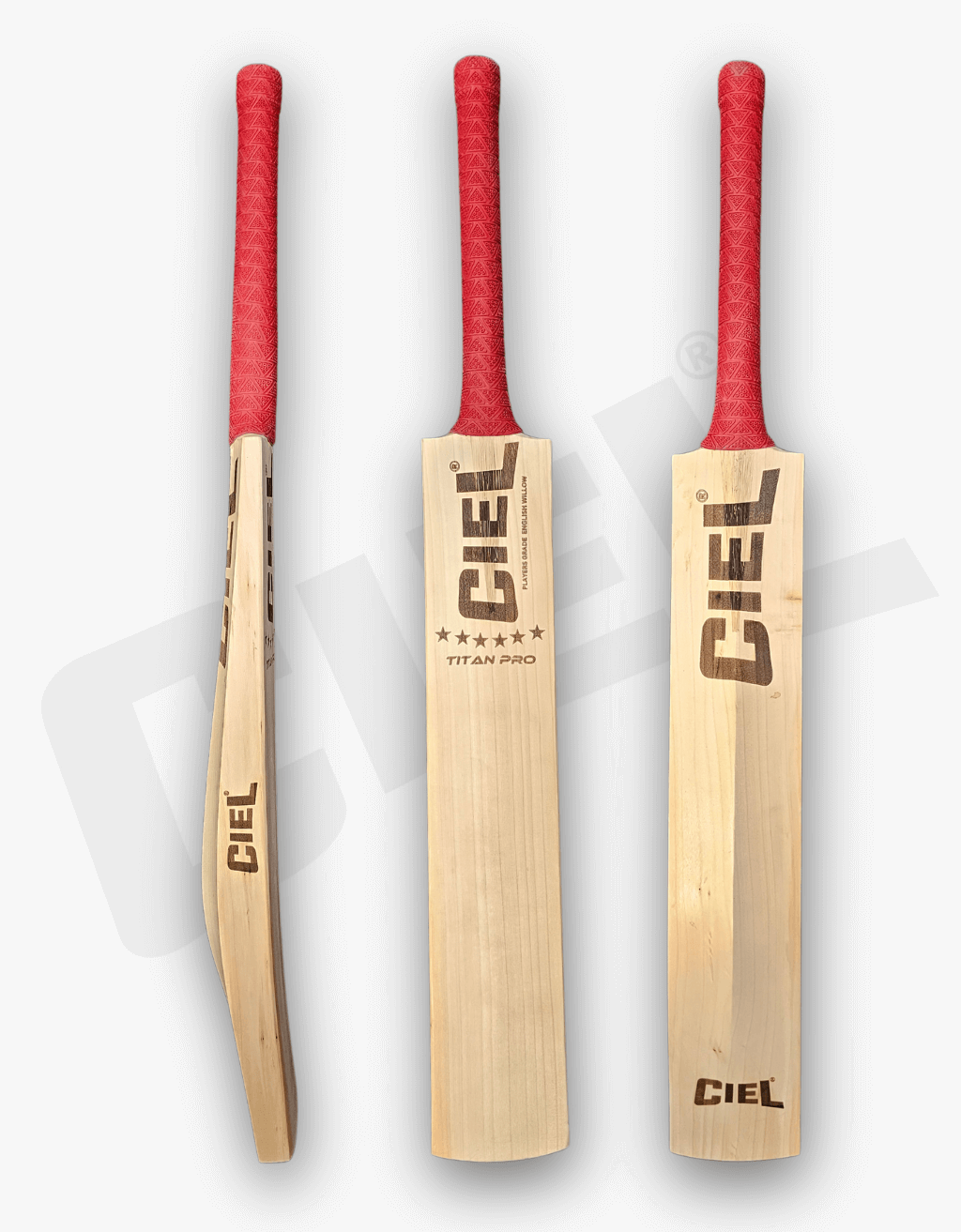
The Striker (Grade 1, Rs.23,999) uses English willow that performs categorically better than any Kashmir willow bat for leather ball cricket. The Dominator (Grade 1+, Rs.36,999) uses willow from the top 4–10% of available clefts — the same quality tier that serious state and district cricketers use. The Titan Pro (Player Grade, Rs.49,999) uses the top 1–3% of all available English willow — the same standard as professional cricketers worldwide.
At factory-direct prices, the scientific advantage of English willow is accessible at every level of serious club cricket. This is what factory-direct from Meerut actually means.
Our English Willow Recommendations
Frequently Asked Questions
Why do professional cricketers use English willow bats? +
What makes English willow special for cricket bat making? +
Can cricket bats be made from other types of wood? +
Is English willow from India the same as English willow from England? +
Why is Meerut the cricket bat capital of the world? +
What is the difference between English willow and Kashmir willow? +
Does the science of English willow apply at club cricket level? +
The science that makes professionals choose English willow. Factory-direct from Meerut.
Grade 1 from Rs.23,999. Grade 1+ at Rs.36,999. Player Grade at Rs.49,999. Same English willow. Same Meerut craftsmanship. Factory-direct price — no distributor, no retailer, no markup. WhatsApp Akshat or Utkarsh at +91 919548182993 to choose the right bat for your game.