
Grade 1 English Willow: Is It Worth the Price?Three conditions decide it — and most buyers meet fewer than three
We sell Grade 1 bats, so take the following with that in mind — and then notice that most of it is an argument for buying a cheaper one.
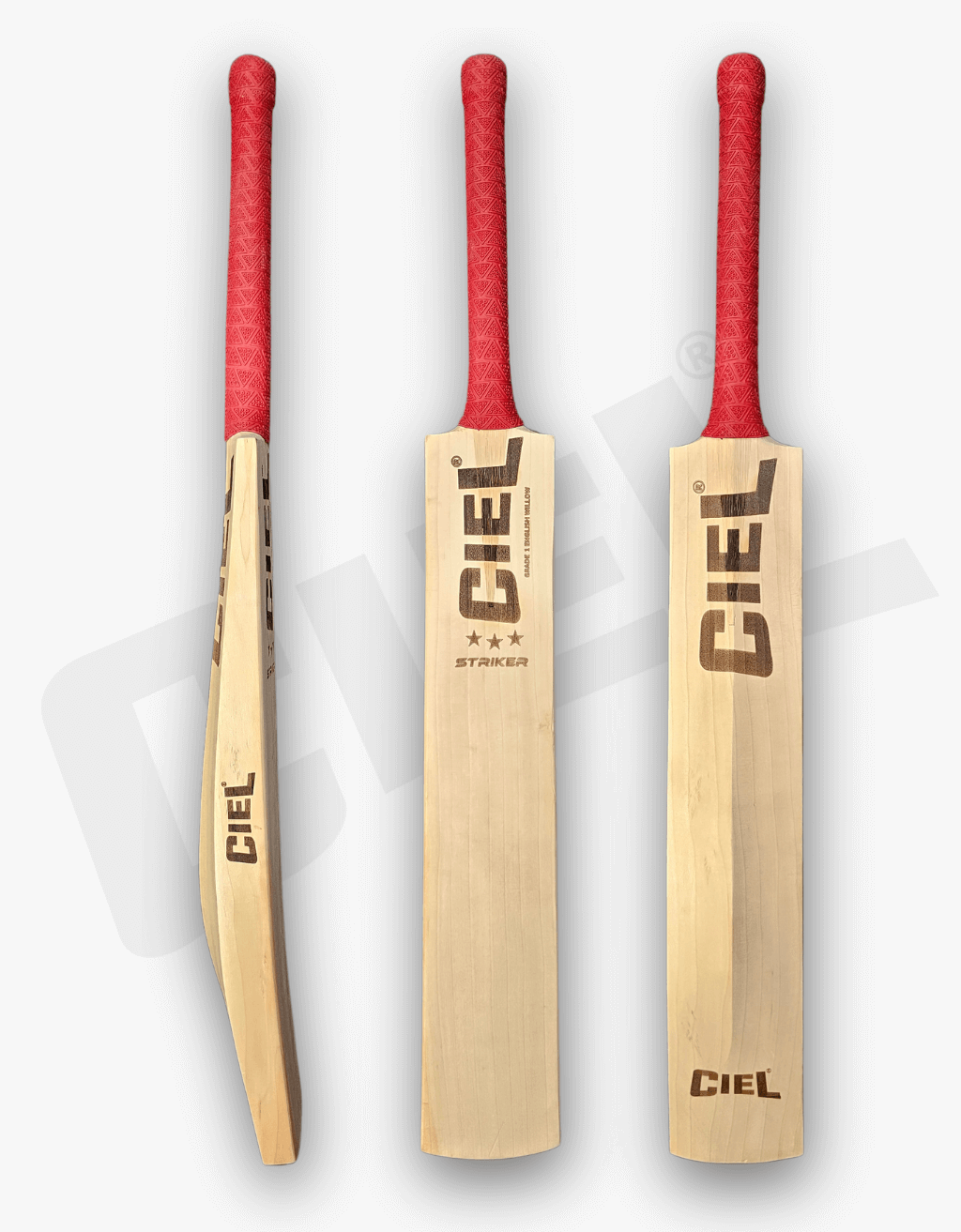
What Grade 1 actually describes
Four things, all judged at the cleft stage before a single cut is made.
- Fibre straightness through the blade — the fibres running cleanly toe to shoulder rather than wandering or angling out at the edges
- Evenness of density from toe to shoulder — the property that decides whether a bat has a dead spot
- No soft patches or internal cracking — invisible from outside, which is why a cleft can look flawless and be rejected
- Moisture content within a narrow band at pressing — too wet and it will not press; too dry and it fractures instead of consolidating
What all four produce, together, is consistency of response: the bat behaving the same way wherever on the face you strike it.
That is the product. Not more power, not a bigger bat — predictability. A ball struck slightly high or slightly toward the edge behaves the way you expected rather than surprising you. Whether that is worth ₹20,999 depends entirely on whether you are in a position to notice it.
Three things it is not
It is not an industry standard
No body defines cricket bat grades. Every maker sets their own, so one maker's Grade 1 can be another's Grade 2. The grade on a sticker is only meaningful relative to whoever assigned it — which is why the useful question is what a maker grades on, not what they call the result.
It is not a bigger bat
Blade dimensions do not rise with grade. Our Vortex at ₹16,999 has similar dimensions to bats costing considerably more. If you want maximum size and mass, that is a shaping decision rather than a grade one.
It is not a better-built bat
This is the one we would most like you to notice. Every bat we make gets the same eight hydraulic press stages, the same multi-piece Singapore cane handle, the same fitted toe guard and the same 12-month handle warranty — from the ₹7,999 Surge upward.
Only the cleft changes. We do not run a shorter process on the cheaper bats, which is precisely why a Vortex is a serious bat rather than a compromise.
The three conditions
Grade 1 is worth its price when all three are true. Not two.
You are middling the ball consistently
Not every ball — but most of your scoring shots come off the middle rather than off the edge or the toe.
Why: Grade 1 buys consistency of response across the face. A player who finds the middle regularly feels that every innings. A player who does not is paying for a property they are not yet in a position to use.
You play regular competitive cricket
League, district or academy fixtures rather than occasional weekend games.
Why: Consistency matters most when every ball counts. In a game where one mistake ends your innings, a face that behaves predictably is worth real money. In a friendly, much less so.
You play on surfaces good enough to show it
Prepared turf with reasonably true bounce, rather than rough outgrounds or matting.
Why: On a slow, low or uneven surface, much of the response advantage is absorbed by the pitch before it reaches you — while the durability disadvantage remains in full.
If any one of those is missing, the honest answer is no — and the money does more good somewhere else. A player with a prepared ₹16,999 bat and complete protection scores more than one with a Grade 1 bat and no thigh guard, because the first commits forward and the second flinches.
The durability inversion
The part that catches people out, because it runs against the assumption that more expensive means tougher.
Higher grades are selected for performance, not durability. A finer cleft is older, lighter and less dense — superb response, and less material to absorb repeated abuse.
Now picture a typical Indian club ground: hard, abrasive, variable bounce, and a bat that also spends several sessions a week in nets against older balls. That workload punishes a fine cleft and suits a dense one.
| Grade 1 | Lower grade / Kashmir | |
|---|---|---|
| Selected for | Consistency of response | Soundness and density |
| Density | Lower | Higher |
| Tolerance of mishits | Lower | Higher |
| Suits | Players middling the ball, decent surfaces | Developing players, nets, rough grounds |
Which leads to the single most useful piece of advice on this page, and it costs us a sale:
If you buy a Grade 1 bat, buy a cheaper one for nets. A net session puts several times more impact through a bat than an innings does. Our Academy Edition at ₹4,499 is Grade 2 Kashmir willow — a denser cleft that is genuinely the right timber for that workload. A ₹4,499 net bat protecting a ₹20,999 match bat is the clearest value decision in cricket.
Our two Grade 1 bats
Both Grade 1, and they are not two versions of the same thing.
| Striker | Inferno | |
|---|---|---|
| Price | ₹20,999 | ₹23,999 |
| Grains | 6–7 | 6–8 |
| Concaving | Yes — conventional | None at all |
| Edges | 40–42mm | 42mm+ |
| Weight | Built to your spec | 1220g minimum |
| Sizes | Full range | Five adult sizes only |
| For | The general Grade 1 answer | Players who specifically want maximum mass |
The Inferno is not an upgrade on the Striker — it is a different bat. No concaving means every gram stays in the blade, which gives maximum mass and edges, and costs you pickup. At 1220g minimum in five adult sizes, it is a specialist choice and it is not suitable for junior players.
If you are choosing between them on price alone, take the Striker. The Inferno is worth its three thousand rupees only if mass is specifically what you want.
If the answer is no
Which it is for a lot of readers, and there is nothing wrong with that.
| You are | Buy | Price |
|---|---|---|
| Still developing, mishitting regularly | Player Edition Kashmir willow | ₹5,999 |
| Moving to English willow for the first time | Surge | ₹7,999 |
| A regular club cricketer, not quite at Grade 1 | Vortex — the one we recommend most | ₹16,999 |
| Playing mostly on matting or rough outgrounds | Kashmir willow, whatever your budget | from ₹4,499 |
And spend the difference on pads, gloves and a thigh guard set. That will do more for your scoring than a finer cleft, and it is not close.
If the answer is yes, and then some
Above Grade 1 sits Grade 1+ and Player Grade — finer clefts with more even density, giving consistent response across a wider area of the face.
- Dominator — Grade 1+, ₹36,999. Our best-selling English willow bat.
- Apex Limited — Grade 1+, ₹42,999. No concaving, like the Inferno.
- Titan Pro — Player Grade, ₹49,999.
Striker to Dominator is a ₹16,000 step, which is the biggest single jump in our range and the one to think hardest about. The three conditions above apply with more force, not less — buy it when your cricket has caught up with it, not in anticipation of that.
Questions buyers ask
Is a Grade 1 English willow bat worth the price? +
It depends on three things: whether you middle the ball consistently, whether you play regular competitive cricket, and whether your surfaces are good enough to show the difference. If all three are true, yes. If any one is missing, the money is better spent elsewhere - usually on protection or a second bat for nets.
What does Grade 1 English willow actually mean? +
At our workshop it describes a cleft where the fibre runs straight through the blade, density is even from toe to shoulder, there are no soft patches or internal cracking, and moisture content was within a narrow band at pressing. It is our standard, not an external one - there is no industry body defining cricket bat grades.
Is Grade 1 the same at every brand? +
No, and this is worth knowing before you compare. No industry body defines cricket bat grades, so every maker sets their own. One maker's Grade 1 can be another's Grade 2. The useful question is not what grade a bat is but what the maker actually grades a cleft on.
Does Grade 1 mean a bigger bat? +
No. Blade dimensions do not rise with grade - our Vortex at ₹16,999 has similar dimensions to bats costing far more. What rises is cleft quality. If you want maximum size and mass, that is a shaping decision rather than a grade one, which is what the Inferno is for.
Does a Grade 1 bat last longer than a lower grade? +
Usually the opposite. Higher grades are selected for performance rather than durability - a finer cleft is older, lighter and less dense, with less material to absorb repeated abuse. On rough club grounds a lower-grade denser bat frequently outlasts a Grade 1 one costing more.
Which of your bats are Grade 1? +
The Striker at ₹20,999 and the Inferno at ₹23,999. Both are Grade 1 English willow and they are different bats - the Striker is a conventional bat with concaving, the Inferno has no concaving at all and starts at 1220g minimum in five adult sizes only.
Should a beginner buy Grade 1? +
Usually not. A developing player mishits frequently, which is exactly the workload a finer cleft handles worst, and the response advantage needs consistent timing to be felt at all. Kashmir willow from ₹4,499 or the Surge at ₹7,999 is the better place to start.
What is the difference between Grade 1 and Grade 1+? +
A finer cleft with more even density, which gives more consistent response across a wider area of the face. Our Striker at ₹20,999 is Grade 1; the Dominator at ₹36,999 is Grade 1+. That is a sixteen thousand rupee step, and it is worth it only when your cricket can exploit it.
Does Grade 1 come with better pressing or a better handle? +
No - and that is the point worth knowing. Every bat we make gets the same 8-stage hydraulic pressing, the same multi-piece Singapore cane handle, the same fitted toe guard and the same 12-month handle warranty, from the ₹7,999 Surge upward. Only the cleft changes with grade.
Is customisation included on Grade 1 bats? +
Yes, and on every other grade too. Profile, handle shape, toe shape, size, weight and engraving are free at every price, because the bat is being shaped after you order it regardless of which cleft it is.
How can I tell if a bat is genuinely Grade 1? +
You cannot verify a sticker, because grades are set by each maker. What you can do is ask what they grade on - a maker describes fibre straightness, density evenness, moisture and soft patches; a reseller repeats the grade back or quotes a grain count. Also ask how many pressing stages, which is the biggest invisible difference between two bats at the same price.
What should I buy if Grade 1 is not right for me yet? +
The Vortex at ₹16,999 for most club cricketers - similar blade dimensions to bats costing twice as much. Or Kashmir willow from ₹4,499 if you are still developing, which is denser and more forgiving of mishits. Then spend the difference on protection, which does more for your scoring than a finer cleft.
Related: what each grade describes, the range under ₹40,000, and why grade stickers mean less than you think.
Made in Meerut · Same build at every grade
Tell us your cricket. We’ll tell you the grade.
Grade 1 from ₹20,999 · Nine English willow bats ₹7,999–₹59,999 · Kashmir willow from ₹4,499 · Same 8-stage pressing, cane handle, toe guard and 12-month warranty on every one · Six specifications free · ₹500 now, balance on delivery