
How Are Cricket Bats Made in Meerut? Inside a Bat Factory
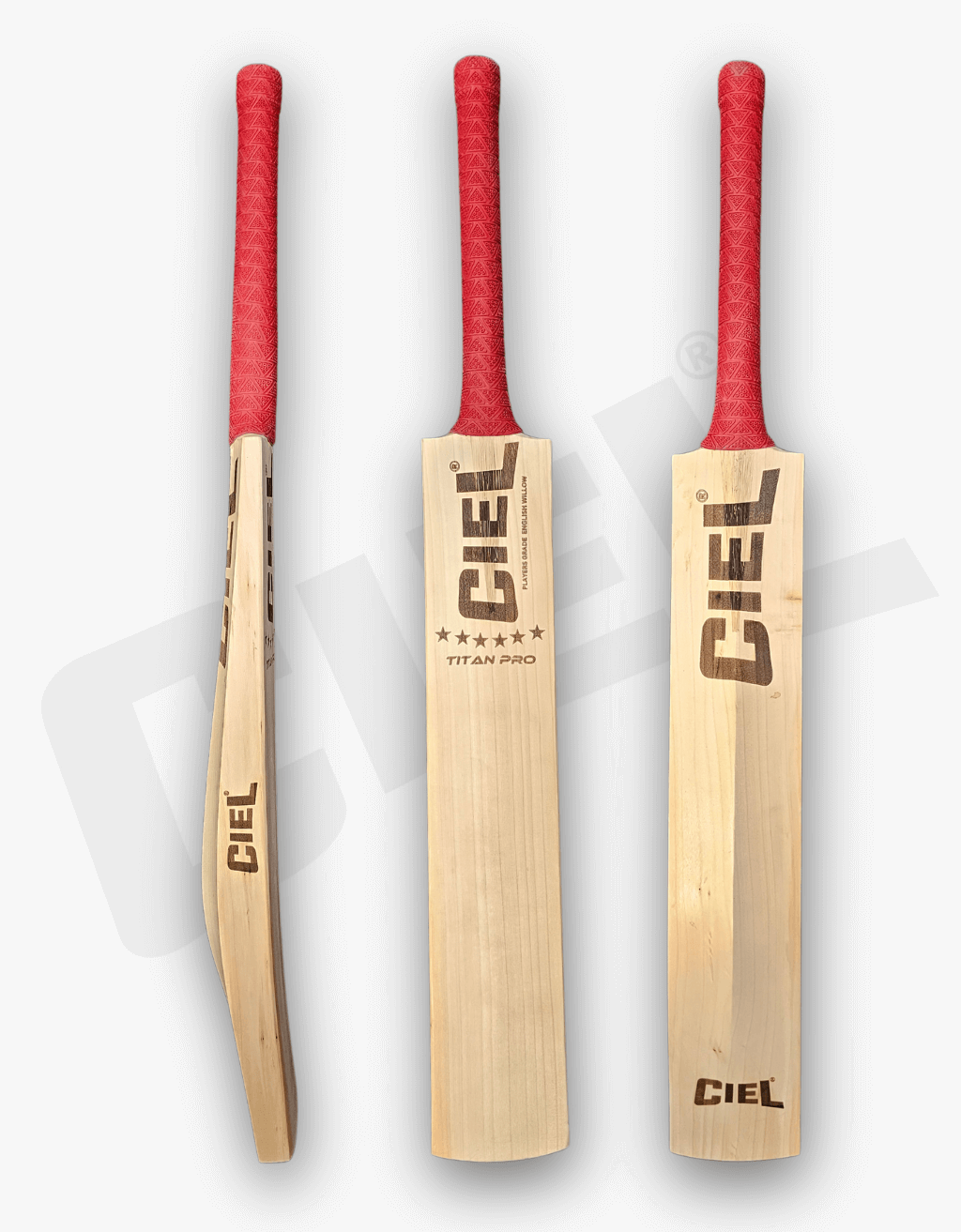
When Virat Kohli drives a ball through the covers, the bat in his hands was almost certainly made in Meerut. When a club cricketer in Melbourne middle-pulls a short ball to the boundary, the bat was almost certainly made in Meerut. Over 70% of the world's cricket bats — from the cheapest Kashmir willow to the finest Player Grade English willow used by Test cricketers — are manufactured in this one city in Uttar Pradesh. At Ciel Sports, we are one of those manufacturers. This is what actually happens inside our factory, from the moment an English willow cleft arrives from England to the moment a finished bat leaves for a player in Delhi, Dubai or Durham.
- Why Meerut? The city that makes the world's cricket bats
- Stage 1 — Where the willow comes from: England to Meerut
- Stage 2 — Cleft inspection and grading
- Stage 3 — Seasoning: the most patient stage
- Stage 4 — Hydraulic pressing: the most misunderstood stage
- Stage 5 — Profile shaping: where the bat gets its character
- Stage 6 — Handle construction and splice fitting
- Stage 7 — Sanding and surface finishing
- Stage 8 — Oiling, toe guard and anti-scuff sheet
- Stage 9 — Stickering, branding and grip fitting
- Stage 10 — Quality control: the final check
- Hand-crafted vs machine-made: what the difference actually means
- What this means for you as a buyer
- FAQ — 6 manufacturing questions answered
1. Why Meerut? The city that makes the world's cricket bats
Meerut is not famous the way Mumbai or Chennai is famous. It is a mid-sized city in western Uttar Pradesh, about 70 kilometres northeast of Delhi. But in the world of cricket, Meerut is the most important manufacturing city on earth — a fact that most cricketers who play with Meerut-made bats every weekend have never been told.
How Meerut became the world's bat capital
The story starts in Sialkot — now part of Pakistan — which was the global centre of sports goods manufacturing in the early 20th century. When India was partitioned in 1947, thousands of skilled craftsmen from Sialkot's sports manufacturing families were displaced. Many settled in Meerut, bringing with them generations of accumulated knowledge about shaping, pressing, and finishing sports equipment.
The Anand brothers — Kedarnath and Dwarakanath — had founded Sanspareils Co. in Sialkot in 1931. After Partition they rebuilt from scratch in Meerut, creating what would eventually become Sanspareils Greenlands (SG) — one of the world's largest cricket equipment manufacturers, still based in Meerut today. Alongside SG, Sareen Sports Industries (SS) and BDM (B.D. Mahajan & Sons) also established themselves in Meerut in the decades following Partition, creating the concentration of expertise that defines the city today.
"More than 80 percent of world cricket bats are made in India. We all are cottage industries and we cannot compete with the big people paying big money for player endorsements. But without our weapons, they are nothing."
— Rakesh Mahajan, Director, BDM Cricket (Meerut), speaking to Reuters2. Stage 1 — Where the willow comes from: England to Meerut
This surprises most people: the wood for English willow cricket bats is grown in England, exported raw to India, shaped and pressed in Meerut, and then shipped back out to the world. The entire global supply of English willow for cricket bats comes from specialist growers in the river valleys of Essex and Suffolk — primarily from a single company: J.S. Wright & Sons, which supplies approximately 75% of the world's cricket bat willow from its plantations in East Anglia.
The Salix alba Caerulea tree
The specific variety grown for bat-making is Salix alba var. Caerulea — cricket bat willow. It is planted in specific conditions: wet, clay-rich river valley soil, at least 10 metres between each tree to allow proper crown development, in the cool, wet climate of East Anglia. Each tree takes 15 to 18 years to reach harvesting maturity. It is felled in winter when sap levels are lowest, cut into rounds, and then split into clefts using a wooden wedge — never sawn, because sawing cuts across grain fibres while splitting follows them.
The cleft arrives in Meerut
Each cleft is a rough wedge-shaped blank, approximately bat-sized, with the ends waxed to prevent splitting during transit. When they arrive at our Meerut factory, they come already externally graded by J.S. Wright's own graders. But at Ciel Sports, every cleft is re-inspected by our own craftsmen before it enters our production process — because the grade assigned at source does not always match our own standards, and no two clefts from the same batch are identical.
Founded in 1894, J.S. Wright & Sons in Essex is the world's largest and oldest supplier of English cricket bat willow. Around 75% of the world's cricket bats are made from their willow — including the clefts that arrive at our Meerut factory. When you buy a Ciel Sports English willow bat, the wood in your hand was grown in Essex, England, selected by J.S. Wright's master graders, and then travelled from England to Meerut to be shaped into your bat.
3. Stage 2 — Cleft inspection and grading
Before any tool touches a cleft, our most experienced craftsmen assess it. This is not a quick visual check. It is a multi-point inspection that determines the grade of the final bat, which profile it is suited for, and whether it meets our standards at all.
The craftsman counts and evaluates the grain lines running vertically down the cleft face. Grains should be straight, evenly-spaced, and parallel from shoulder to toe. Grains that curve, converge, or deviate indicate the cleft was cut off-axis from the tree — which means inconsistent fibre response zones across the blade. These clefts are rejected or downgraded.
Using a moisture meter, the craftsman checks the cleft's moisture content. The target range for pressing-ready willow is 12–15%. Clefts above 15% are too wet — pressing them will cause the fibres to compress unevenly and the bat will feel "dead." Clefts below 10% are too dry — they can fracture under pressing pressure. Clefts outside the acceptable range are set aside for further drying.
The craftsman examines the edge profile of the cleft. Heartwood — the older, denser, darker inner wood of the tree — appears as a brownish band on one or both edges. A small amount is acceptable and cosmetically normal. A large heartwood proportion (more than one-third of the blade width) means the cleft came from closer to the tree's core, where the wood is drier and less flexible. High heartwood bats are harder to press well and more brittle under impact.
Specks, pin knots, butterfly stains, and discolouration are noted. Most surface blemishes are cosmetic — they affect grade classification but not performance. However, knots and structural irregularities in the fibre direction can create weak points that affect how the bat presses and how it holds up under sustained ball impact. These are flagged and addressed during shaping.
The craftsman holds and flexes the cleft, assessing its weight relative to its size. Lower density clefts — which feel lighter than expected for their volume — yield bats with better pickup and a larger effective sweet spot. Higher density clefts will produce heavier bats and require more aggressive pressing. This assessment determines whether the cleft will become a standard profile or a lower-weight bespoke build.
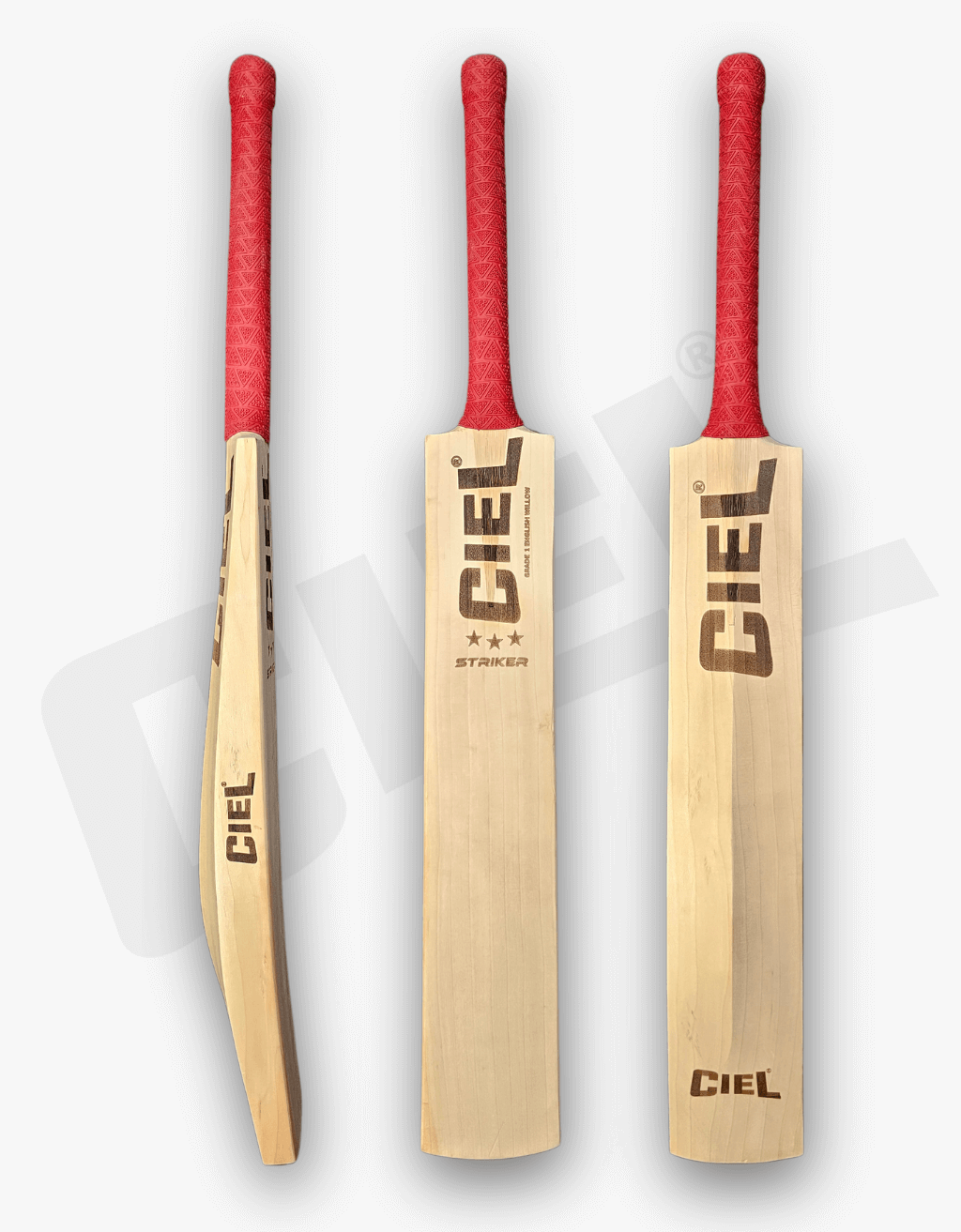
At Ciel Sports, we reject clefts that do not meet our standards. This is not an industry-wide practice. Many lower-price manufacturers accept any cleft that arrives, then compensate for poor wood quality with aggressive pressing — which produces a bat that feels hard but has no spring. When we say "Grade 1 English willow" on our Striker bat, we mean a cleft that passed our inspection at this stage. The grade starts here, before a tool has touched the wood.
4. Stage 3 — Seasoning: the most patient stage
Fresh willow contains natural sap and moisture that must be removed before the cleft can be pressed or shaped. A cleft pressed at high moisture content will develop an uneven surface, warp over time, and never produce a consistent ping. Rushing the seasoning stage — which many factory-line manufacturers do — is one of the primary reasons so many inexpensive bats feel "dead" after a few months of use.
How we season English willow clefts
When clefts arrive from J.S. Wright's in England, they have already been through initial air-drying at source. We continue the drying process in our Meerut factory through a combination of air-drying and controlled kiln-drying. The total drying time for premium English willow clefts at Ciel Sports is 6 to 12 months from receipt — significantly longer than the 6–8 weeks used in factory-line production.
- Target moisture content: 12–15% — the range at which willow fibres are supple enough to compress under pressing without fracturing, but dry enough to produce a hard, consistent surface
- Storage orientation: Clefts are stored horizontally, face-up, in controlled humidity conditions. Vertical storage or uneven humidity causes warping
- Slow drying is essential: Wood dried too quickly develops micro-cracks in the surface fibres — invisible at first, but they become visible after the first season of play. Slow seasoning allows the wood to stabilise uniformly through its full depth
"The willow itself took 15 to 18 years to grow. A bat maker who rushes seasoning to 6 weeks to save money is disrespecting both the tree and the player who buys it. We take 6 to 12 months because the wood demands it."
— Ciel Sports Manufacturing Team, Meerut5. Stage 4 — Hydraulic pressing: the most misunderstood stage
Of all the stages in cricket bat manufacturing, pressing is the one most players have heard of but fewest understand. Most players know "more pressing = better." But the reality of what pressing actually does — and what the difference between 2 stages and 8 stages means — is more nuanced than that.
What pressing physically does to the willow
A hydraulic press applies a heavy roller across the face of the bat blade under up to 2 tonnes per square inch of pressure. This force compresses the outer 3 to 5mm of surface fibres — the zone that makes direct contact with the leather ball — into a hard, dense layer. Unpressed willow fibres sit loosely, like a pile of loosely-stacked fibres. Pressed willow fibres are compacted into a rigid, spring-loaded surface.
The physics of what happens when a ball strikes pressed willow are directly related to this compression. The surface fibres deform under impact — absorbing the energy — then spring back elastically, transferring the stored energy back into the ball as forward velocity. This is the ping. The better the pressing, the more elastic the rebound. The worse the pressing, the more energy is lost as heat and vibration.
Why 8 stages matters at Ciel Sports
The industry standard for factory-line bats is 2 to 4 pressing stages. At Ciel Sports, every English willow bat goes through 8 stages of hydraulic pressing. Here is exactly why the number of stages matters:
- One pass compresses approximately 1–2mm of fibre depth. Two passes compress approximately 2–4mm. Eight passes compress the full critical zone of 3–5mm uniformly and deeply.
- Resting between stages is essential. After each pressing pass, the willow needs time for the compressed fibres to settle before the next pass. Rushing multiple passes in sequence without resting can over-compress the surface — creating a bat that is hard but has no spring. We rest clefts between stages.
- Multiple passes from slightly different angles ensure the entire face — including the zones near the edges and toward the toe — receives consistent compression. A single-pass pressing machine only compresses the central strike zone effectively.
- More stages = less home knock-in needed. A 2-stage pressed bat may need 10+ hours of home knock-in before match use. Our 8-stage pressed bats typically need 6–8 hours — because 50% of the work is already done.
- Full 3–5mm fibre depth compressed
- Uniform compression face to edges
- Resting period between each stage
- Maximum ping from first session
- 6–8 hours home knock-in needed
- Longer peak performance window
- 1–3mm fibre depth compressed
- Central zone better than edges
- Often rushed without resting
- Slower to develop full ping
- 10–12+ hours home knock-in needed
- Performance peaks later, shorter window
It is possible to press a bat too much. Over-pressing compresses the fibres so densely that the wood loses its natural elastic spring entirely. The bat feels very hard but the ball does not "ping" — energy is absorbed rather than transferred back. Some manufacturers over-press low-grade bats to make them feel harder than they are. The result is a bat that never develops a proper ping regardless of how much you knock it in. Our craftsmen assess each cleft individually and calibrate pressing intensity accordingly.
6. Stage 5 — Profile shaping: where the bat gets its character
If pressing gives a bat its performance, shaping gives it its character. The profile — the three-dimensional shape of the blade — determines where the sweet spot sits, how the bat feels in the hands, how it picks up, and which playing style it suits. This is the stage that requires the most human skill and the most time.
The tools of hand shaping
Our bat makers shape each blade using a combination of traditional and modern tools:
- Draw knife: A two-handled blade used to rapidly remove large amounts of wood from the back of the blade, establishing the rough spine height and shoulder profile. Requires considerable skill — too much pressure and the grain tears; the right angle and the wood peels cleanly.
- Spoke shave: A smaller plane-like tool used to refine the back profile, blend the spine into the shoulders, and establish the transition from spine to edges. The bat maker shapes by feel as much as by eye — pressing the blade against their body, feeling the balance and pickup change with every stroke.
- Block plane: Used for precise, controlled removal of wood in specific zones — particularly around the shoulders and the toe transition. The bat maker checks pickup continuously throughout this stage.
- Edge spoke shave: A curved tool specifically for rounding and profiling the edges — creating the characteristic rounded edge profile that maximises edge mass while maintaining the correct blade geometry.
The 5 profiles we offer — and why profile matters
At Ciel Sports, every bat is available in 5 profiles named after the batting styles of international cricketers. Profile is determined by spine height and position, edge thickness, and the location of maximum blade mass:
- Virat Kohli (Duckbill): High spine tapering quickly to a flatter toe. Sweet spot in the mid-blade. Ideal for front-foot batters who play drives and work the ball through the line.
- Rohit Sharma (Mid-to-Low Swell): Medium-high spine with mass concentrated in the lower mid-blade. Our most popular profile. Suits openers and aggressive batters who pull and cut.
- MS Dhoni (Bottom-Heavy): Low spine with maximum mass at the toe. For finishers and unorthodox batters who target the lower half of the blade.
- Andre Russell (Full Profile): Even spine and mass distribution from shoulder to toe. Minimum concaving. Maximum willow mass. For T20 power hitters who need a reliable hitting zone across the entire blade.
- Sachin Tendulkar (Traditional Full): Continuous spine from handle to toe, even distribution, no pronounced swell. The all-conditions, all-format profile. Suits technically correct players who bat long.
At most factory-line manufacturers, a CNC machine is programmed with a single standard template for each model. Every bat of that model receives an identical profile, regardless of the individual characteristics of the cleft. At Ciel Sports, our bat makers read each cleft individually — assessing its density distribution, grain straightness, and natural weight balance — and make micro-adjustments to the profile to bring out the best performance from that specific piece of wood. Two bats of the same profile from the same batch may be fractionally different — because the wood demanded it.
7. Stage 6 — Handle construction and splice fitting
The handle of a cricket bat is an engineering achievement in its own right. Its job is to do three things simultaneously: transmit the batter's hand movement to the blade with precision; absorb the shock and vibration of ball impact so it does not travel painfully into the wrists and forearms; and provide a comfortable, secure grip under the stress of fast bowling.
What the handle is made from
Professional cricket bat handles are made from Singapore (Sarawak) cane — specifically the rattan palm Calamus scipionum, which grows primarily in the tropical forests of Southeast Asia. This species has a specific combination of properties that make it uniquely suited for bat handles: it is lightweight, extremely strong under lateral bending, and mildly elastic under compression.
The cane is not used as a single round piece. Instead, multiple cane strips are laminated together with rubber inserts — sheets of rubber placed between the cane strips before the handle is assembled. The rubber serves as a shock absorber — converting the sharp, high-frequency vibration from ball impact into a softer, lower-amplitude sensation that the batter feels as a controlled sensation rather than a jarring shock.
The splice: the most critical joint in the bat
The connection between the handle and the blade — the splice — is a precision V-shaped joint that determines how efficiently energy transfers from blade to hands. Here is how we fit it:
- A precise V-shaped channel is cut into the top of the blade using a purpose-built machine. The angle and depth of the V are critical — too shallow and the joint is weak; too deep and the blade loses structural integrity at the shoulders.
- The base of the handle is shaped to match the V exactly — not approximately, but precisely. The handle should fit the splice with minimal force, creating a perfect friction fit.
- Wood glue is applied to both surfaces. The handle is inserted and the joint is clamped overnight — a minimum of 12 hours — before any further work is done on the bat.
- The craftsman checks that the handle is set slightly forward, aligned with the bow of the bat. This ensures the handle sits in the natural batting grip position rather than fighting against the batter's natural wrist angle.
We offer a 12-month warranty on the handle of every Ciel Sports bat. This covers handle breakage and splice failure under normal use conditions. The warranty reflects our confidence in the quality of our splice joints and our Singapore cane handles. If your handle breaks within 12 months of purchase, we replace it at no cost. WhatsApp +91 95481 82993.
8. Stage 7 — Sanding and surface finishing
Sanding a cricket bat is not a simple surface smoothing exercise. It is a progressive process of six to eight passes through decreasing grades of sandpaper — from coarse (80 grit) through medium (120, 180) to fine (240, 320, 400) — that creates the smooth, satin surface the bat needs for its protective treatments to bond correctly and for the face to respond consistently to ball contact.
The critical insight about sanding that most players do not know: sanding is itself a final light pressing of the surface fibres. Each pass of fine sandpaper micro-compresses the outermost fibre layer, contributing to the surface hardness and the ping of the finished bat. This is why the sanding quality of a bat directly affects its performance — not just its appearance.
At Ciel Sports, the final two sanding passes are done entirely by hand — not machine. Our craftsmen run the sandpaper along the grain direction only, in smooth, even strokes. Cross-grain sanding creates micro-scratches that show under oil and affect surface consistency. A bat finished by machine sanding alone will never achieve the same surface uniformity as one finished by hand.
9. Stage 8 — Oiling, toe guard and anti-scuff sheet
Before a finished bat leaves our factory, it receives its first application of raw linseed oil at the manufacturing stage. This is not the same as the knock-in oiling you do at home — it is a factory-stage sealing of the surface fibres to prevent moisture loss during transit and storage.
The oil is applied to the face, edges, and toe — carefully avoiding the splice and handle. It is allowed to absorb for 24 hours, then any excess is wiped off. The bat is then inspected for any surface imperfections that appear under oil — which sometimes reveals micro-cracks or fibre irregularities invisible on a dry surface.
Toe guard fitting
The toe is the most moisture-vulnerable part of the bat — the wood is end-grain at this point, meaning it absorbs water far faster than the face or edges. A toe guard is fitted over the toe before the bat ships. This is a critical protection step — leaving the toe unguarded exposes it to moisture absorption from damp pitches and grass, which swells the fibres and causes splitting.
Anti-scuff sheet (optional)
An anti-scuff sheet is a thin, clear polyurethane film applied to the face of the bat. It reduces surface wear from ball impact and prevents the face fibres from lifting under repeated contact. It does not affect performance — the ball contact is through the sheet, not around it. We offer anti-scuff sheets as a factory option. Bats without a sheet need more frequent oiling to maintain the face.
10. Stage 9 — Stickering, branding and grip fitting
The final visible stages before quality check: stickering, grip wrapping, and weight marking. At Ciel Sports these stages reflect our direct-to-player philosophy — the bat you receive carries our brand, not the logo of a multinational that played no part in making it.
The handle is first bound with twine wound under tension, glued in place, and left to cure. The binding reinforces the handle cane construction and provides the structural base for the rubber grip. The grip is then rolled onto the handle from toe to top using a grip cone tool — creating an even, wrinkle-free fit that stays in place through a full season.
Stickers are applied to the face, back, and shoulders of the bat. Weight is checked on a scale. Every Ciel Sports bat is weighed at this stage — players ordering within a specific weight range (e.g. 1150–1190g) receive a bat that has been verified at this step, not estimated.
11. Stage 10 — Quality control: the final check before dispatch
Every Ciel Sports bat goes through a final quality inspection before it is packed for dispatch. This is not a tick-box exercise. It is a physical assessment conducted by our most experienced craftsman, covering six areas:
The craftsman grips the blade and the handle separately and applies lateral force — testing the splice joint for any movement. Any play or flex at the splice means the joint has not cured correctly or the fit was imprecise. Bats that fail this check are stripped and re-spliced.
A thumbnail is pressed firmly into the sweet spot and held for 3 seconds. On a properly pressed bat, no mark should remain. If a visible dent appears, the bat needs more pressing before it ships. This is the same test we recommend players use before their first match.
The craftsman picks up the bat and performs a slow full drive movement, assessing pickup, balance point, and swing feel. A bat that feels noticeably heavier or lighter than its stated weight at this stage is re-weighed and the discrepancy is investigated.
The craftsman strikes the sweet spot firmly with a bat mallet and assesses the sound. A correctly pressed, well-seasoned bat produces a clear, resonant ping. A dull thud indicates insufficient pressing or a moisture issue in the cleft. These bats are returned for additional pressing sessions.
Both edges are checked for consistent roundness and surface compression. The toe is checked for correct toe guard fitting and any signs of end-grain cracking. Edge or toe issues at this stage are repaired before dispatch.
The surface finish, sticker alignment, grip fit, and overall cosmetic condition are assessed. At Ciel Sports, bats that fail cosmetic standards are not shipped — they are reworked or repurposed. A player paying Rs.39,999 for a Player Grade bat should receive a bat that looks as good as it performs.
12. Hand-crafted vs machine-made: what the difference actually means
The phrase "hand-crafted" appears on the packaging of bats at every price point. It has become so overused that it has lost almost all meaning. Here is what the distinction actually means in manufacturing terms — and why it matters for performance.
- Each cleft individually assessed before shaping
- Profile adjusted for that specific cleft's characteristics
- Draw knife and spoke shave used throughout shaping
- Craftsman monitors pickup and balance continuously
- Final sanding done entirely by hand along grain
- Mallet ping test at quality control stage
- 4–6 hours of active shaping time per bat
- Clefts processed in batches to a standard template
- CNC machine shapes all bats identically
- Human finishes edges and sanding only
- No individual cleft assessment
- Machine sanding throughout
- Visual QC only — no mallet test
- 15–20 minutes of human time per bat
The practical result: a genuinely hand-crafted bat made from a well-assessed cleft with an individual profile will outperform a factory-line bat of the same stated grade, from the same stated wood, at every level of the game. The wood quality matters. The manufacturing process matters more.
13. What this means for you as a buyer
Understanding how your bat is made gives you a completely different framework for evaluating value. Most players compare bats by brand name, grade label, and retail price. None of those three things tells you much about the quality of what is inside the packaging.
The questions that actually matter when buying an English willow bat:
- How many pressing stages? 2 stages and 8 stages are not the same bat. Ask the manufacturer directly.
- How long was the willow seasoned? 6 weeks and 6 months produce fundamentally different bats. Most retailers cannot answer this because they do not know.
- Is the profile hand-shaped or CNC? The answer determines how well the bat was optimised for that specific cleft.
- Does the price reflect wood quality or supply chain cost? A Rs.35,000 bat from a retailer may contain the same willow as a Rs.35,000 bat from a factory-direct manufacturer — but one of those prices includes three layers of middlemen.

14. Frequently asked questions — answered by the manufacturer
Where are most of the world's cricket bats made? +
How long does it take to make one cricket bat? +
What does hydraulic pressing do to a cricket bat? +
Why are cricket bats made in Meerut specifically? +
What is the difference between a hand-shaped bat and a machine-made bat? +
Why does my pressed bat still need knocking in at home? +
Buy direct from the Meerut factory.
No distributor. No retailer markup. English willow Grade 1, 1+ and Player Grade — 8-stage pressed, hand-shaped, and quality-checked at our Meerut factory before dispatch. Free shipping across India. Ships to 50+ countries.