
English Willow vs Kashmir Willow for Club Cricket India: Better Investment?
English Willow vs Kashmir Willow for Club Cricket in India: Which Is the Better Investment?
Every Indian club cricketer eventually faces the same question: should I spend Rs.20,000+ on an English willow bat, or is a Rs.5,000 Kashmir willow good enough for my level? Most answers they get are either vague ("English willow is better for serious players") or wrong ("English willow always lasts longer"). At Ciel Sports, we manufacture both — English willow bats from Rs.21,999 and Kashmir willow from Rs.3,499. We sell to 80,000+ players across India. This is the honest, numbers-based answer — with real rupee prices, real lifespan data, and the cost-per-match calculation that no other guide has actually done.

- The real question: cost per match, not cost per bat
- How long does each bat actually last? The honest lifespan data
- The cost-per-match calculation — 4 real scenarios with rupee numbers
- The performance gap — when it matters and when it does not
- The pitch factor — how Indian playing surfaces affect the decision
- The net practice question — which bat should you use in nets?
- 6 player profiles — which bat is right for you
- 5 myths about English willow and Kashmir willow — busted
- When is the right moment to upgrade from Kashmir to English willow?
- FAQ — 6 investment questions answered by the manufacturer
1. The real question: cost per match, not cost per bat
The wrong way to compare English willow and Kashmir willow is to look at the price tags — Rs.21,999 vs Rs.5,999 — and conclude that English willow is 3.7 times more expensive. That comparison ignores the single most important variable: how long each bat lasts in match use.
The right way to compare them is cost per match — how much does one match of cricket cost you from this bat's total lifespan? A Rs.5,999 bat that lasts 1 season of 30 matches costs Rs.200 per match. A Rs.21,999 bat that lasts 3 seasons of 30 matches (90 matches total) costs Rs.244 per match. The cheaper bat costs less per purchase. The expensive bat costs only marginally more per actual game — and delivers significantly better performance in every one of those games.
This reframe changes the entire decision — and it is the calculation that no other comparison guide in India has actually done with real rupee numbers for real Indian playing scenarios. Let us do it now.
2. How long does each bat actually last? The honest lifespan data
Kashmir willow lifespan
A Grade 1 Kashmir willow bat used in regular club cricket with a hard leather ball typically lasts 1 to 2 seasons. Here is why: Kashmir willow is denser than English willow, which makes it more resistant to the kind of surface damage that comes from mishits and rough handling in nets. But density is a double-edged quality — the wood does not have the elastic spring of English willow, and under sustained hard leather ball impact at club and district pace, the face gradually compresses permanently rather than recovering elastically. After 12–18 months of regular use, the ping is gone, the surface is dented, and the bat is functionally dead even if it looks intact.
Important nuance: a Kashmir willow bat used only for net practice — not for matches — will last significantly longer, potentially 3–5 seasons, precisely because net balls are lighter or more worn. The problem is most club players use the same bat for everything.
English willow lifespan
A correctly prepared English willow bat (properly oiled, knocked-in for 6+ hours, oiled every 4–6 weeks during the season) lasts 2 to 4 seasons of regular club cricket. The key phrase is "correctly prepared." The elastic fibre structure of English willow that creates its superior ping is also what makes it responsive to preparation and maintenance. A bat that is knocked-in properly can sustain 3 full seasons. A bat used in its first match without knock-in may crack in the second over.
Many sources claim "Kashmir willow lasts longer than English willow." This is technically true in one specific scenario: a bat stored in a cupboard and used twice a year. In real club cricket conditions — 20–40 matches per season, nets 3 times a week, leather ball — the opposite is true. English willow that is correctly prepared outlasts Kashmir willow in sustained match use because its elastic fibre structure recovers between innings while Kashmir willow's denser fibres gradually compact permanently.
3. The cost-per-match calculation — 4 real scenarios with rupee numbers
Here are four realistic Indian club cricket playing scenarios with real Ciel Sports prices. These calculations assume correct bat preparation and maintenance. They use conservative lifespan estimates — the lower end of the expected range.
4. The performance gap — when it matters and when it does not
The performance difference between English willow and Kashmir willow is real. But it is not equally real at every level or on every surface. Here is the honest picture.
When the performance gap matters
- On fast, true turf pitches: When the ball comes onto the bat quickly with pace, English willow's elastic rebound creates a meaningful difference in the power and timing of drives and cuts. The ball comes off faster and cleaner.
- At district level and above: Against faster bowlers (70+ km/h), the extra pickup speed and sweet spot responsiveness of English willow directly affects the ability to time the ball and play attacking shots.
- For developing technique: English willow gives better feedback from every ball. The distinct difference between a middle-bat hit and a mis-hit is clearer — which trains a player's contact awareness faster.
- In long innings: After 30–40 overs at the crease, the lighter effective pickup of English willow means the arms tire less. The bat feels the same in over 40 as in over 1.
When the performance gap does not matter much
- On slow matting pitches: When the ball does not come onto the bat with pace, the elastic rebound advantage of English willow is far less noticeable. Kashmir Grade 1 plays equally well on most matting surfaces.
- For beginners and first-year players: A player who is still developing their batting technique does not yet have the timing consistency to exploit English willow's larger sweet spot. The bat's performance advantage is wasted on a player who is still finding the middle once every ten balls.
- In net practice: The difference between hitting throwdowns with English willow vs Kashmir willow is almost imperceptible. This is why using your English willow bat in nets is a waste of its lifespan for negligible benefit.
"A Grade 1 Kashmir willow bat at Rs.5,000–Rs.6,000 often performs as well as a Grade 4–5 English willow bat at the same price. The assumption that 'English is always better' does not hold at the lower end of the English willow range."
— CricJosh.in, independent cricket analysis site5. The pitch factor — how Indian playing surfaces affect the decision
| Surface type | English willow advantage | Verdict |
|---|---|---|
| Fast, true turf (well-prepared) | High — ball comes onto bat with pace. Elastic rebound creates real power difference. | English willow recommended |
| Hard, dry turf (typical Indian club) | Moderate — uneven bounce creates mishits. English willow's larger sweet spot helps. | English willow recommended |
| Slow, low turf (outground) | Low — ball stops on the bat. Must work harder for power regardless of bat type. | Either works — Kashmir is better value |
| Matting (coir or astroturf) | Low — consistent bounce reduces the pickup advantage. Good technique matters more. | Kashmir Grade 1 is better value |
| Indoor nets (synthetic) | Negligible — use Kashmir willow to protect your English willow bat. | Kashmir willow — always |
| Rough outfield / festival cricket | Negative — rough ball damages English willow face faster. Kashmir more durable. | Kashmir willow recommended |
The practical takeaway: if you play on proper turf pitches for competitive matches, English willow is worth the investment. If you play primarily on matting or slow surfaces, the performance advantage shrinks significantly and Kashmir Grade 1 is the smarter choice.
6. The net practice question — which bat should you use in nets?
This is one of the most important — and most ignored — questions in bat care for Indian club cricketers. You should not use your English willow match bat in net practice. Here is the exact reason.
A typical net session involves 100–200 balls over 45–60 minutes. In a match, you might face 30–60 deliveries per innings. Net practice exposes the bat to 3–5 times more ball impact per session than a match. Net balls are frequently harder (older red balls that are harder than worn leather), thrown by a bowling machine at consistent impact points, or hit off the face by mishits from fellow batters sharing the net.
Every net session with your English willow match bat uses approximately 3–5 matches' worth of the bat's lifespan. A player who uses their Rs.21,999 Striker bat in nets 3 times a week is effectively paying match prices for net practice — and shortening their match bat's life significantly.
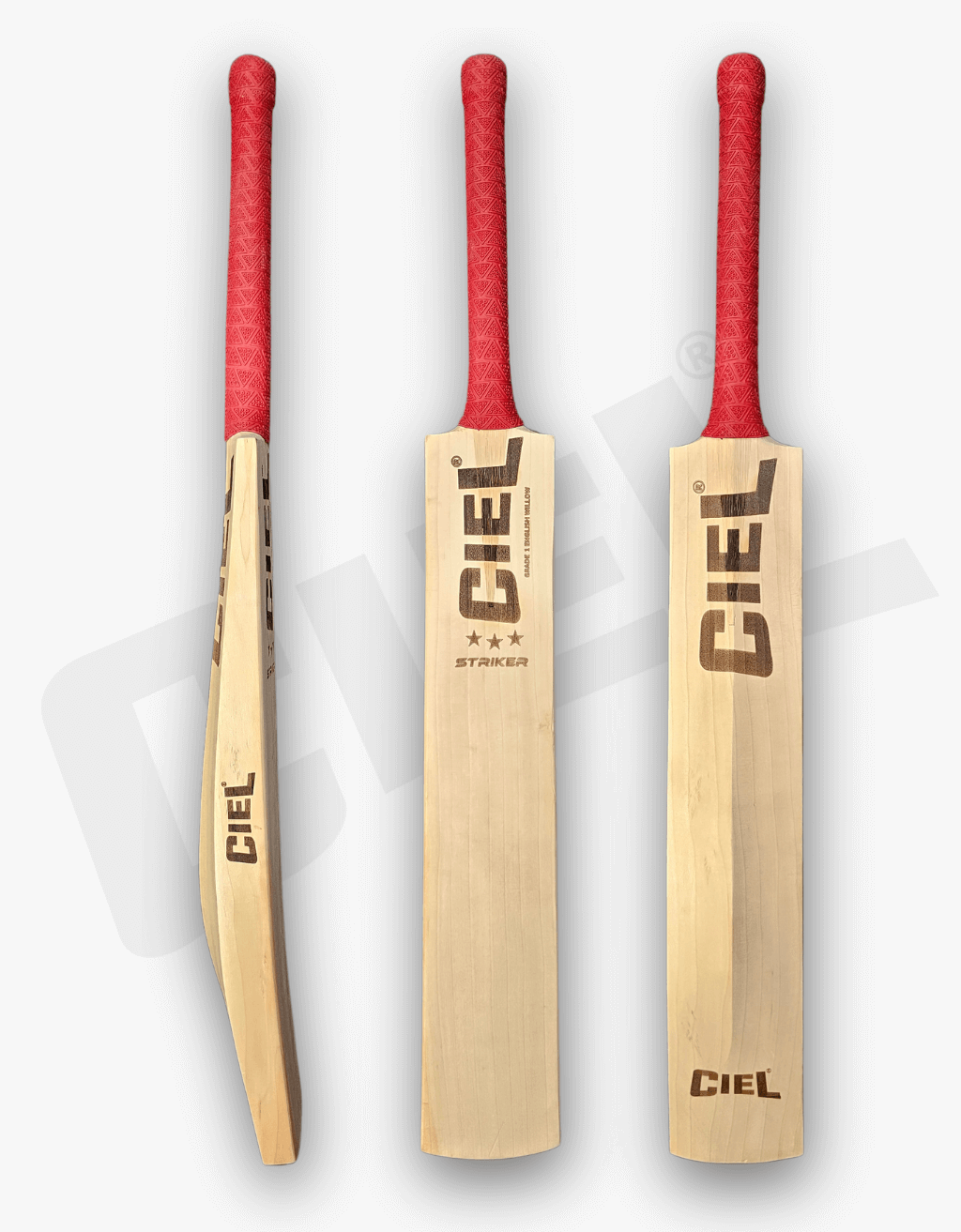
The solution is the two-bat strategy from Scenario D above: a dedicated Kashmir willow bat for all net sessions, and the English willow bat reserved for match cricket only. The Ciel Sports Killer Edition (Rs.4,999) is specifically designed for this purpose — durable, well-pressed, grade 1 Kashmir willow that handles repeated net use without the careful maintenance schedule an English willow bat requires.

7. Six player profiles — which bat is right for you
8. Five myths about English willow and Kashmir willow — busted
9. When is the right moment to upgrade from Kashmir to English willow?
This is the question every developing club cricketer in India is really asking. Here are the four signals that tell you the upgrade moment has arrived:
- You are consistently middle-batting the ball. You hit the sweet spot regularly enough to feel and appreciate the difference between a middle-bat hit and a mis-hit. English willow makes this feedback clearer and more rewarding.
- You are playing 20+ competitive matches per season. The playing frequency justifies the cost-per-match calculation. Below 15 matches, Kashmir willow is still better value. Above 20 on turf, English willow starts to make sense.
- You are playing on proper turf pitches. The surface needs to support the performance advantage. If all your cricket is on matting, the upgrade can wait.
- Your Kashmir willow bat is limiting you. You can feel that well-timed shots are not travelling as far as they should. The ball doesn't "ping" off the face. You find yourself working harder for the same result. This is the bat ceiling — and it is real.
10. Frequently asked questions — answered by the manufacturer
Is English willow worth it for club cricket in India? +
How long does an English willow bat last in club cricket? +
How long does a Kashmir willow bat last in club cricket? +
Should I use my English willow bat in net practice? +
Should a beginner buy an English willow bat in India? +
Is a cheap English willow bat better than an expensive Kashmir willow bat? +
Whichever willow is right for you — we make both.
Grade 1 Kashmir willow from Rs.3,499. Grade 1 English willow from Rs.21,999. All bats 6–8 stage pressed, hand shaped, factory-direct from Meerut. Free shipping India. Ships to 50+ countries. Not sure which is right? WhatsApp +91 95481 82993.